Good morning and welcome to FirstFT. In today’s newsletter:
-
Scott Bessent prepares to launch “economic D-Day” against Iran
-
Fast-fashion retailer Shein names IPO date
-
The privacy debate over AI glasses
-
The FT’s financial education charity lunch
You can listen to today’s top news stories in the FT News Briefing podcast.
US Treasury secretary Scott Bessent is preparing to announce new sanctions against Iran in what he said would be an “economic D-Day” in the war against the Islamic state.
In an article published in the Financial Times today Bessent said “economic D-Day” would begin at dawn and would be “the single greatest financial offensive ever marshalled against an adversary” as he outlined the case for fresh economic measures.
Bessent did not mention China by name but singled out Iran’s “enablers” that purchase and transport its energy exports as the target of the new measures.
“The regime’s final refuge now lies in the self-deception of fearful nations that still believe accommodating aggression can secure a durable peace,” he wrote.
China is the biggest customer for Iran’s oil. Last year Iran’s oil exports to China averaged 1.4mn barrels per day, according to ship-tracking firm Kpler. The press conference is scheduled to begin at 1pm Eastern Daylight Time.
The new US economic measures come after weeks of tortuous diplomatic talks have gone nowhere. Energy exports through the Strait of Hormuz, a vital artery for world oil and gas supplies, have slumped since the start of the war, now in its sixth month, and prices have soared, pushing up inflation around the world.
Before the war, about 20mn barrels of crude and refined products flowed through the strait every day. Now traders believe that number has dropped between 4mn and 6mn barrels a day. On Monday, Brent crude, the international benchmark, was 1.1 per cent lower at $93 a barrel after rising 13 per cent over the past two weeks. Iran, meanwhile, threatened dozens of ships with fines or confiscation as it steps up efforts to assert control over the Strait of Hormuz.
Iran’s economy has been shattered by months of war and a US naval blockade on its ports. Inflation has surged as the country’s currency, the rial, has fallen to record lows against the dollar. On Monday, the rial dropped to a fresh low of 2.02mn against the dollar ahead of Bessent’s announcement. My colleague Bita Ghaffari in Tehran wrote recently about the economic difficulties many in the country are facing.
Here’s what else we’re keeping tabs on today:
-
Ukraine: Leaders from the Coalition of the Willing are in Kyiv for commemorations of the country’s 35th anniversary of independence. British Prime Minister Andy Burnham will sign an agreement allowing Kyiv to use shared French and British long-range missile technology.
-
Economic data: Mexico is scheduled to publish final second-quarter GDP. Also due are June economic activity, measured by the IGAE, and first-half August inflation.
-
Company results: Dick’s Sporting Goods is the latest retailer to publish second-quarter results. The athletic and footwear retailer is expected to report a rise in revenue.
Five more top stories
1. The fast-fashion retailer Shein is seeking a $27bn valuation in a Hong Kong listing next week, almost three-quarters below its peak after previous attempts to list foundered amid pushback by regulators. The China-founded company plans to raise as much as HK$14bn (US$1.8bn) in a September 1 listing, according to a listing notice published by Hong Kong’s stock exchange earlier today.
-
More Chinese tech news: Alibaba shares dropped on Monday after the Chinese ecommerce and cloud group launched a HK$80bn ($10.2bn) share sale in Hong Kong as it steps up capital expenditure to compete with the world’s leading artificial intelligence companies.
2. The Canadian dollar is weaker today after the collapse of trade talks between the US and Canada over the weekend. US lawmakers, governors and business leaders yesterday warned that Washington’s new tariffs on Canadian goods would increase costs for American households and companies.
3. Shell has drawn interest from potential bidders including ExxonMobil and LyondellBasell for its multibillion-dollar US chemicals assets. Shell’s US chemicals plants are located across four sites in Louisiana, Texas and Pennsylvania, producing a wide range of chemicals for use in plastics, detergents and pharmaceuticals, and could be worth as much as $8bn, people familiar with the talks said.
4. Anthropic’s US customers are using cheaper alternatives to its most powerful AI tool, raising questions about the group’s high-spending business model ahead of what is expected to be the biggest IPO of all time. Spending on Fable 5, Anthropic’s largest and priciest model, has plateaued, according to spending data from 70,000 companies collected by payments group Ramp.
5. Kevin Warsh will seek to soothe investors’ nerves in the coming week in what could be a crunch moment for the US Federal Reserve chair. Warsh will address central bankers and economists at the Kansas City Fed’s Jackson Hole gathering on Friday for the first time since his appointment amid mounting signs of economic strain in the US. Here’s what to expect.
AI is coming for your glasses

Executives at Meta, Google, OpenAI and other tech companies hope smart glasses and other similar portable products could one day replace the smartphone as our main gateway to AI. But critics denounce the wearables as “cringe stalkerware”. Tim Bradshaw and Hannah Murphy delve into the simmering privacy debate over AI glasses.
We’re also reading . . .
-
Ad astra: Greater access to satellite systems is allowing more African scientists to gather and use data to help solve their countries’ problems.
-
Private credit: The sector has piled up investments on life insurers. Patrick Jenkins writes that there are three areas of concern with the model.
-
Geostrategic shift: Climate change is reshaping world trade, financial markets, logistics and geopolitics, writes Rana Foroohar.
Chart of the day
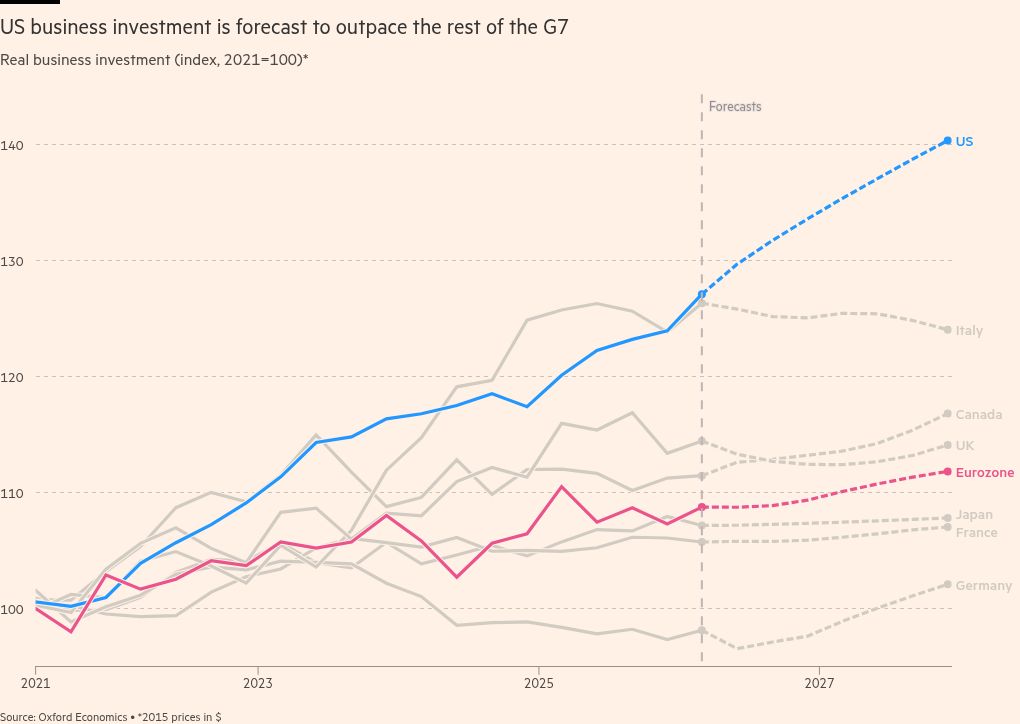
Business investment in the US is on track to rise more than three times faster than in Europe in the six years since the pandemic, according to forecasts that highlight the AI-driven gulf opening between the two economies. Oxford Economics said corporate spending on new equipment and facilities in the US is projected to increase 40 per cent in real terms between 2021 and the end of next year, compared with a real-term rise of just 12 per cent in the euro area.
Take a break from the news . . .

To celebrate the fifth anniversary of FLIC, the FT’s financial education charity, we are offering a spectacular roster of top journalists in the 2026 charity lunch auction. Win and you can lunch with your favourite columnist at one of the top restaurants in London or New York, all of which are kindly hosting us free of charge. Find out more here.
For the next few days, FirstFT Europe/Africa will arrive 90 minutes later than usual. You will see us in your inboxes at 7am BST/8am CET.