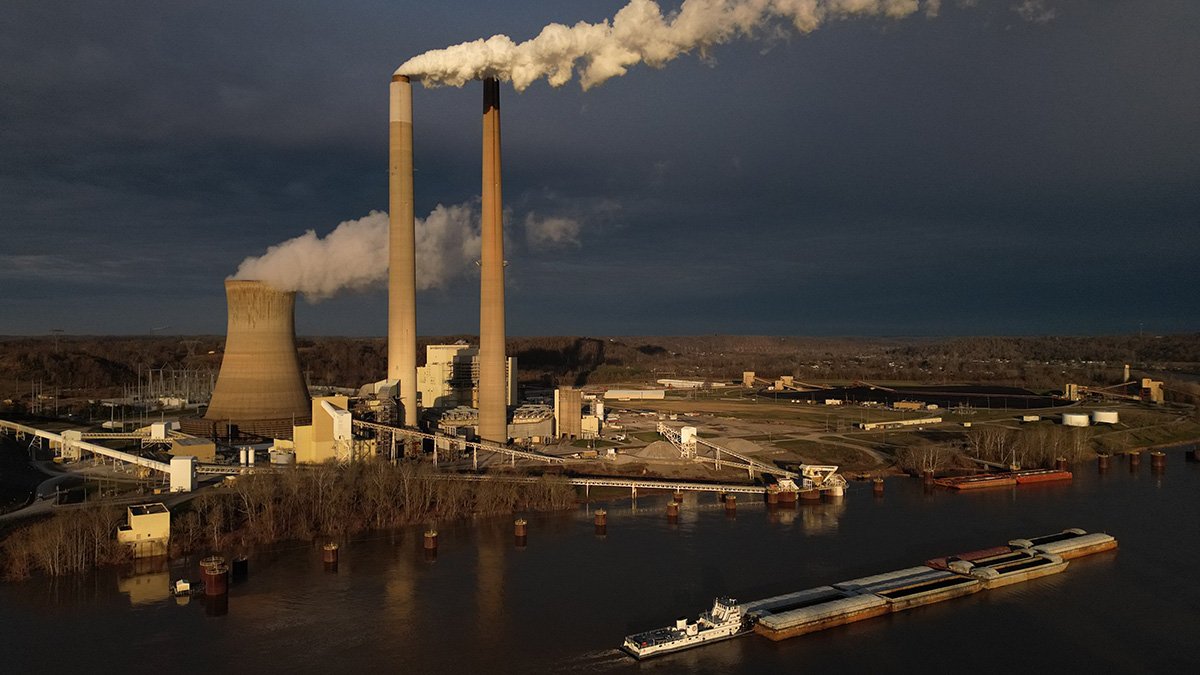
The Environmental Protection Agency said Monday it is repealing rules that limit planet-warming greenhouse gas emissions from power plants fueled by coal and natural gas, an action the agency said would remove more than $300 billion in costs for the industry and help “unleash” American energy.
The rule change, first proposed last year, represents a fundamental shift from efforts by Democratic Presidents Joe Biden and Barack Obama to address climate change and clean up industrial pollution.
Environmental groups decried the change, saying it would come at a cost to Americans’ health and further degrade the environment. EPA officials said the change would allow utilities to make the best decisions for their ratepayers rather than be forced to close aging or inefficient plants.
The rule is expected to face immediate legal challenges. In a related action, the EPA proposed a separate rule, expected to be made final next year, that could prevent future administrations from regulating greenhouse gas emissions from power plants. The proposal follows on EPA’s action earlier this year revoking a scientific finding that long has been the central basis for U.S. action to regulate greenhouse gas emissions and fight climate change.
The Environmental Protection Agency announced Thursday that it will rescind the Obama-era legal finding which allowed the department to limit greenhouse gas emissions.
The February action eliminated all greenhouse gas emissions standards for cars and trucks. The new plan would apply similar logic to a broader undoing of climate regulations on stationary sources such as power plants.
The announcements came as EPA chief Lee Zeldin, Interior Secretary Doug Burgum and Energy Secretary Chris Wright host a G20 ministerial meeting on “energy abundance” in Houston. The announcement of the rule, coming on the same day, is both a nod to the important role oil-rich Texas plays in the energy industry and a potential snub of European and other international allies in attendance who have pursued environmentally friendly policies that the Trump administration has moved to undo.
Republican President Donald Trump called climate change “the greatest con job ever perpetrated on the world” at a speech to the United Nations last year, and his administration withdrew the U.S. — for the second time — from the 2015 Paris climate accord that sets voluntary goals to curb planet-warming emissions.
Trump has boasted of U.S. energy abundance even as the Iran war continues to disrupt global fuel markets and gas prices top $4.31 a gallon, up more than a dollar from a year ago.
The rollbacks are meant to fulfill Trump’s repeated pledge to “unleash American energy” and make it easier for utilities to supply electricity for homes and businesses.
The power plant rule is among nearly three dozen environmental regulations that Zeldin targeted in early 2025 when he announced what he called the “most consequential day of deregulation in American history.”
Zeldin said in proposing the new rules last year that they were meant to end the Biden and Obama administrations’ “war on so much of our U.S. domestic energy supply.”
Environmental and public health groups called the rollbacks dangerous and vowed to challenge the rules in court.
“Tearing down our national protections against climate pollution from power plants will have enormous costs for the health, safety and well-being of families across the country,” said Vickie Patton, general counsel for the Environmental Defense Fund. “Americans everywhere are already suffering from record-breaking heat, more dangerous floods and storms, and skyrocketing insurance costs.”
The EPA has a legal responsibility to protect the public from harmful pollution, Patton said, adding that “clean, affordable and reliable technologies are widely available to power our homes and businesses.”
Coal, gas and oil-fired power plants are responsible for about one-quarter of the nation’s total climate pollution, second only to the transportation sector. Pollution from power plants is one of the largest sources of climate-changing pollution in the world.
The rules targeted by Trump’s EPA could prevent an estimated 30,000 deaths and save $275 billion each year they are in effect, according to an Associated Press examination last year that included the agency’s own prior assessments and a wide range of other research.
Even a partial dismantling of the rules would mean more pollutants such as smog, mercury and lead — and especially more tiny airborne particles that can lodge in lungs and cause health problems, the AP analysis found. It would also mean higher emissions of greenhouse gases, driving Earth’s warming to deadlier levels.
Biden, a Democrat, had made fighting climate change a hallmark of his presidency. Coal-fired power plants would have been forced to capture smokestack emissions or shut down under a strict EPA rule issued in 2024. Those rules are now being upended.
In its proposal last year, the Trump EPA argued that carbon dioxide and other greenhouse gases from fossil fuel-fired power plants “do not contribute significantly to dangerous pollution” or climate change and therefore do not meet a threshold under the Clean Air Act for regulatory action. Greenhouse gas emissions from coal and gas-fired plants “are a small and decreasing part of global emissions,″ the EPA said.
Zeldin, a Republican and former New York congressman, said Biden-era actions were designed to “suffocate our economy in order to protect the environment,” with the intent to regulate the coal industry “out of existence” and make it “disappear.”
The coal industry and groups representing coal-fired power plants have denounced the Biden rule as “overreach” by the EPA and urged its repeal. Lifting the rule will protect grid reliability and shield electricity consumers from higher costs at a time of surging demand from data centers, artificial intelligence and advanced manufacturing, according to America’s Power, a trade organization for the U.S. coal fleet.