COVID-19 is on the upswing in California and across a swath of the West and the South, a sign that the virus may be starting its seasonal summer uptick.
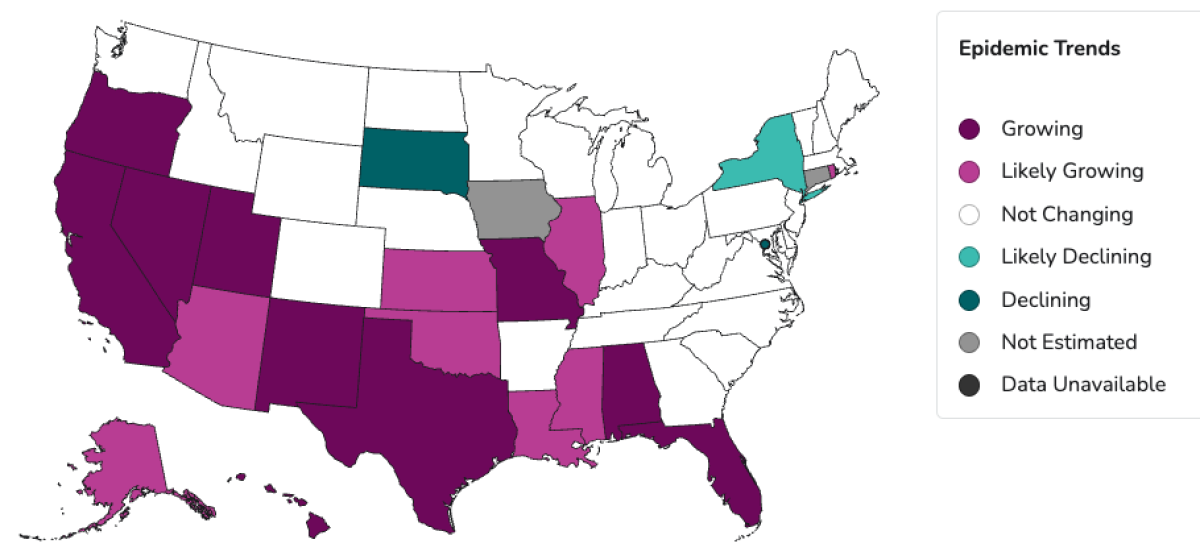
The U.S. Centers for Disease Control and Prevention estimates that COVID is growing in California, Texas, Florida, Missouri, Alabama, Oregon, Utah, Nevada, New Mexico and Hawaii. Levels of COVID-19 in those states — measured by the share of emergency room visits caused by COVID — still remain very low, the CDC said.
Other data points also suggest COVID is rising.
“COVID-19 activity has been gradually increasing across California based on test positivity trends. Wastewater concentrations are also increasing,” according to Grant Boyken, a spokesperson for the California Department of Public Health.
For the week that ended July 18, 3.4% of COVID tests in California came back positive. That’s lower than at the same time in the prior two years, but it’s still an increase from a month ago, when the test positivity rate was 1.15%.
According to health officials and experts, it wouldn’t be surprising for a summer increase in COVID to begin now. Large numbers of people haven’t fallen ill with COVID for quite a while.
“We’re kind of due for more people getting sick,” said Dr. Peter Chin-Hong.

COVID is growing across a swath of the West and South, according to the U.S. Centers for Disease Control and Prevention.
(U.S. Centers for Disease Control and Prevention)
“Hopefully, that won’t happen. But I think that’s what we’re worried about,” said Chin-Hong, a UC San Francisco infectious diseases expert. At the moment, however, UC San Francisco is not seeing a lot of COVID cases in its hospitals, he noted.
Kaiser is noticing a small increase in COVID cases just in the last two weeks — nearly all of them outpatients, said Dr. Elizabeth Hudson, regional physician chief of infectious diseases at Kaiser Permanente Southern California.
The COVID test positivity rate in L.A. County started rising after the Fourth of July holiday. According to county data, the rate was 4.28% for the week that ended July 11, up from 1.52% a week earlier.
“The next few weeks will tell us if we’re going to see another summer of increased COVID activity,” Hudson said.
The test positivity rate is also increasing in Orange County, with 3% of COVID tests coming back positive for the week that ended July 11, up from 1.3% a month ago.
In Northern California, wastewater detections and the COVID test positivity rate are up in San Francisco, the city’s Department of Public Health said. Levels of coronavirus in the wastewater in San José and Palo Alto are considered “high,” the Santa Clara County Public Health Department said.
“Summer increases in COVID-19 activity have occurred yearly since 2020, so it is not unexpected to see more activity at this time,” state health officials said.
Hospitalization rates remain “very low” across California but are expected to rise in the coming weeks. “The percentage of emergency department visits and the percentage of deaths attributed to COVID-19 are both lower than levels seen during the same time frame” in the last two years, according to the state Department of Public Health.
State officials continue to recommend that all individuals age 6 months and older stay up to date on COVID-19 vaccinations. The most recent version of the COVID vaccine came out in September.
“This is particularly important for higher-risk individuals, such as infants and toddlers, pregnant individuals, older persons, and others with risks for serious disease,” health officials said.
“Some groups of people may need multiple doses and those age 65+ or immunocompromised need two doses six months apart. For those who have not received an updated dose or are due for their second dose, vaccination is recommended before the summer wave,” the agency said, recommending that those groups get the current 2025-26 version of the vaccine this summer while waiting for the 2026-27 version, which will be released in the fall.
Worldwide, COVID activity was generally low and stable for the last week of June, according to the World Health Organization, although there was elevated activity or increases in parts of Latin America, northern Europe, parts of Africa and Southeast Asia.
Health officials in Taiwan reported an increase in COVID activity there, and were monitoring increasing viral activity in Japan, South Korea, Hong Kong and China, according to the island’s Central News Agency. Medical providers in Taiwan were reporting some strain with patients coming in with COVID as well as seasonal flu; infections were expected to peak in mid-August, local news outlets reported.
COVID has become less deadly since the early years of the pandemic, when the virus was new to humanity and there were neither vaccines nor medicines to treat those who were sickened. COVID-19 was the third leading cause of death in the U.S. in 2020 and 2021, the fourth leading cause in 2022, and the 10th leading cause in 2023. By 2024, COVID became the 15th leading cause of death nationwide.
In 2020, there were 385,676 deaths involving COVID nationwide; in 2021, 463,267 deaths; in 2022, 247,168 deaths; in 2023, 76,055 deaths; in 2024, 47,541 deaths; and in 2025, 20,685 deaths, according to a CDC database.
That is still a significant number of deaths, experts say, and the virus can still lead to development of long COVID and other health problems.
The hope is that a summer COVID uptick will continue to be weaker than in previous summers. But even then, the disease will still cause suffering and death for some victims, according to Chin-Hong.
Doctors say those who remain at particular risk of severe COVID are older people, immunocompromised people, those who are pregnant and those who are younger than 5, especially infants.
“We’ve seen zillions of waves of COVID, but babies haven’t,” Chin-Hong said.
“I think that we have to protect the most vulnerable,” he said. It’s especially important for the most vulnerable groups of people to get a fresh COVID vaccination at least once every year, Chin-Hong said.
People who get sick with COVID should also remember that, if they get diagnosed early, for many there is the option of asking for drugs to reduce the length and intensity of illness, such as Paxlovid.
“If you’re over age 65 or are younger but at a higher risk for complications — e.g., you have diabetes, heart disease, obesity, asthma or have a weakened immune system for other reasons like cancer — you can get a COVID-19 booster now,” Hudson said. “This will help you avoid getting COVID-19 now during what may turn out to be another summer surge.”