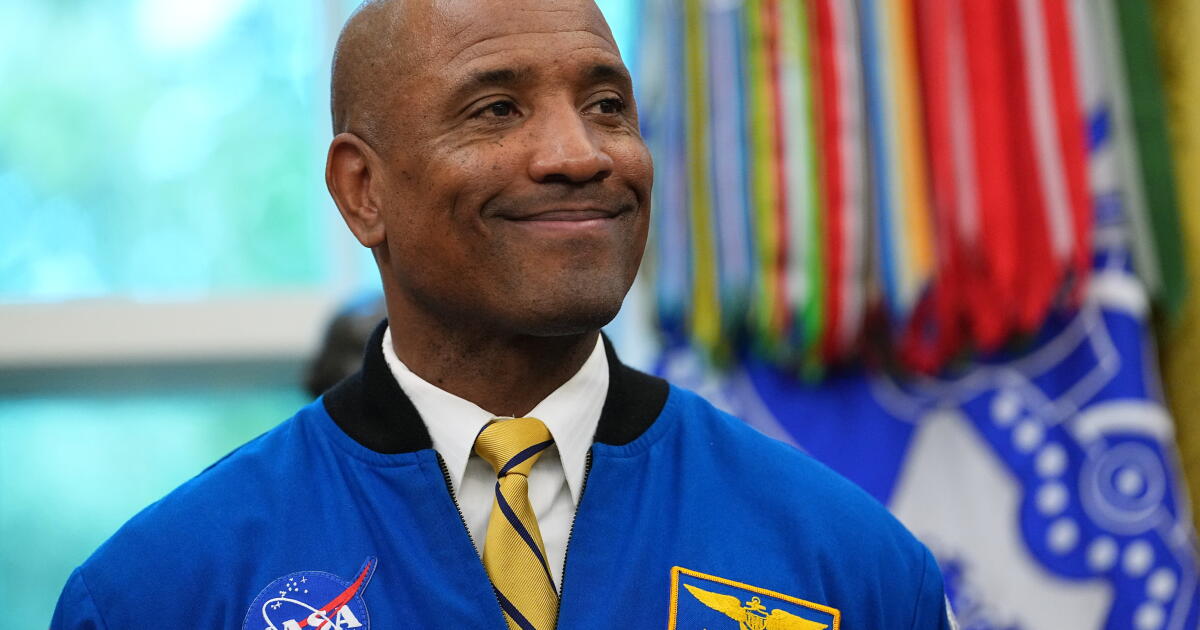
Astronaut Victor Glover, a Southern California native who piloted NASA’s Artemis II mission around the moon this year, will step back from the space agency and begin a full-time leadership role at his alma mater, Cal Poly San Luis Obispo, the university announced Wednesday.
As the only pilot to have flown NASA’s moon-faring Orion capsule, Glover will support future lunar missions under the agency’s emeritus program. He plans to continue observing flight simulations as astronauts train to land on the moon and working with the teams who will support Artemis missions from the ground.
“It was really important for us to be close to our kids and really focus on our family,” Glover said in an interview with The Times on Wednesday. “And I still get to do the things that really matter to me … even here at NASA, my favorite days have been talking to the interns and being with the family members when their crewmember launches to space.”
Cal Poly has always held a special place in Glover’s heart. He met his wife, Dionna, on campus while both were students. All four of his daughters have either graduated or are attending the university.
Glover’s crewmate, Artemis II Cmdr. Reid Wiseman is also retreating from astronaut duties to join the emeritus program, NASA announced Wednesday. Artemis II mission specialist Jeremy Hansen said in July he would step back from the Canadian Space Agency this month.
Out of the crew of four, that leaves only Artemis II mission specialist Christina Koch as a full-time astronaut.
In his new role, Glover will work closely will Cal Poly’s president to position the university as a “global leader in polytechnic education, research innovation and workforce production,” the news release said. He will also work on initiatives to “inspire the next generation of students” to pursue science, technology, engineering and math.
After the success of Artemis II, Glover said he’s felt a responsibility to give back to the next generation of astronauts and students.
“I would be derelict in my duty if we didn’t try to do the most good with this — I didn’t join the astronaut corps to be famous,” he said. “I don’t want to be on stage for the rest of my life. I want to take that energy and shine that light on these young people who want to be the leaders.”
In June, Glover visited Cal Poly to speak to an audience of nearly 1,300 about his experience flying around the moon. In August, he made a surprise appearance at a fall semester welcome event in the university’s stadium.
“I’ll tell you, that was actually a really tough week. It was emotional to move my youngest daughter into the dorms,” he said. “And when I walked out on the field, and everybody just started cheering, it just felt like being home.”
Glover was born in Pomona and graduated from Ontario High School. During his upbringing, he lived “all over” Southern California’s urban sprawl, including Baldwin Village. He graduated Cal Poly in 1999 with a degree in engineering.
After serving in the military for 15 years — including as a Navy test pilot — he was selected by NASA for its 21st class of astronauts in 2013.
At the space agency, he piloted the first operational mission of SpaceX’s Crew Dragon capsule to the International Space Station in 2020. In April, he piloted NASA’s first mission to return humans to the moon in more than 50 years.
While the Artemis II crew did not land on the lunar surface, the astronauts’ expressions of awe for the lunar surface and profound love for Earth captured the public’s attention.
“Maybe the distance we are from you makes you think what we’re doing is special,” Glover said on Easter while on his way to the moon. “But we’re the same distance from you, and — I’m trying to tell you, just trust me — you are special. In all of this emptiness — this is a whole bunch of nothing, this thing we call the universe — you have this oasis, this beautiful place that we get to exist, together.”