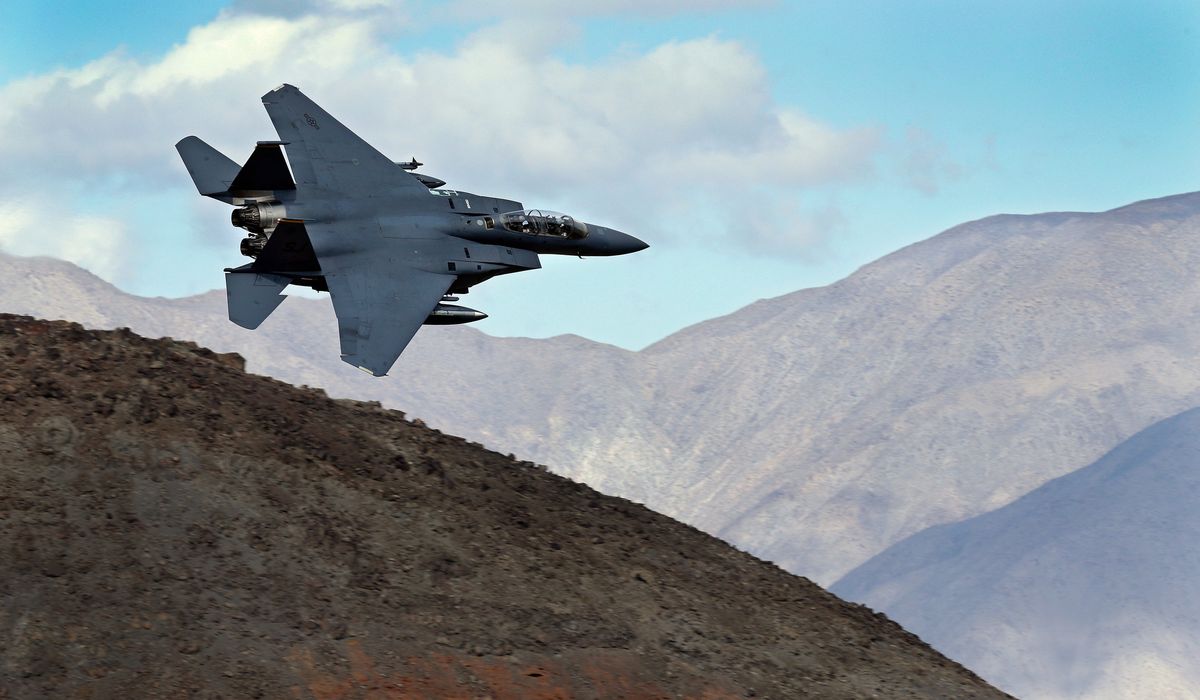
An Air Force officer who spent two days inside enemy territory after his F-15E Strike Eagle fighter jet was shot down over Iran in April credited his religious faith for helping keep him alive until his dramatic rescue.
The officer, identified with his mission call sign “Dude 44 Bravo” to shield his identity, told CBS’ “60 Minutes” on Sunday that his $30 million aircraft was brought down by an Iranian shoulder-fired missile that can cost about $100,000.
He said the missile strike felt like getting hit by a freight train. Both he and his pilot, identified as “Dude 44 Alpha,” ejected from the aircraft. Alpha landed safely, but Bravo’s parachute didn’t fully deploy. He broke his back, arm and shoulder on impact.
“I don’t have this story without faith,” he told CBS’ Norah O’Donnell. “I’m not saying faith is [a] replacement for training. Training helps us understand what we do. But faith is the backstop of all my actions.”
Their mission was to strike Iranian industrial facilities that were part of Tehran’s drone and missile program, officials said.
Alpha was rescued by U.S. forces about seven hours after the jet was shot down. Bravo was the weapons system officer, managing the aircraft’s sensors, targeting, navigation and weapons systems in the back seat.
Badly injured and in a valley surrounded by jagged cliffs, Bravo climbed a 7,000-foot ridgeline to evade capture. Iranian officials had placed a $60,000 bounty on his head.
“I had injuries. But we all train to adapt and overcome the things that we’re faced with,” Bravo told “60 Minutes.” “Never let a lack of motivation put you on Iranian TV.”
Advertisement
He managed to send out a short radio message to his comrades: “God is good.”
There were some concerns the message might have been sent by Iranians to ambush a rescue force, but U.S. officials eventually confirmed it came from Bravo.
The mission to extract Bravo was one of the largest and most complex combat search-and-rescue missions in U.S. history. Dozens of aircraft, including fighter jets, helicopters and tankers, along with at least 100 special operations troops, played a role in the operation, officials said.
Bravo said spotting an Air Force para-rescueman, known as a PJ, on the ridgeline near his position was “one of the greatest memories of my life.”
After two days on his own spend evading Iranian forces, Bravo was finally able to call his wife back home.
Advertisement
“I was really proud of her and grateful for the strength that she showed,” he told “60 Minutes.”
Story Topics