By agreeing to a settlement with California Atty. Gen. Rob Bonta and other state attorneys general, Paramount Skydance has cleared the last major hurdle to its merger with Warner Bros. Discovery.
The five-year settlement agreement, which still needs approval from a judge, runs the gamut. It ranges from obligations that the combined company release at least 30 films a year and separately negotiate its basic cable channel agreements, to investment in an independent film fund.
Importantly for California, there’s also a pledge not to sell or close Paramount’s Melrose Avenue lot or the Warner Bros. lot in Burbank and to operate them “in a manner consistent with past practices.”
But there are still questions about what this blockbuster deal will ultimately mean for Southern California and its struggling film industry.
The settlement requires the combined company to spend at least $300 million more a year on U.S. production — which works out to a total of about $1.5 billion for the five-year period.
That spending could rise, but only contingent on the success of two legislative measures.
If the U.S. government passes a federal film and television tax incentive, Paramount must increase its domestic production levels to 20% for the first two years of the agreement and then 30% for the final three years.
And if either California or New York passes an uncapped tax credit that includes expenses ranging from crew labor to salaries for actors and directors, Paramount must then up its U.S. production to 40%. Currently, only about 5% of Paramount’s global production happens in the U.S., according to Bonta’s office, so that would be a substantial boost.
On the federal incentive front, there is bipartisan momentum to push for such an initiative, and President Trump has indicated his support after a visit from actor and Hollywood ambassador Jon Voight.
But an uncapped tax incentive in California is a tall order, especially after the large lobbying effort required last year just to increase the annual cap and expand eligibility criteria, though Bonta said he was committed to working with the Legislature on this issue.
It’s also worth remembering that the settlement requirements also don’t necessarily mean that California alone would benefit. Many states have beefed up their production capabilities, notably New Jersey, New York and Texas even as California has seen a steady loss in market share.
For his part, Paramount Chief Executive David Ellison has pledged his support of California, saying the combined company will be headquartered in Los Angeles.
“Now that we reached and announced a settlement, we’re eager to get to work building a stronger Hollywood,” he said in a statement Monday. “We aren’t going anywhere. Our history is here, and this is where our future is being built.”
That announcement came after Paramount had threatened to leave California for Texas or Tennessee during the throes of testy negotiations with Bonta and other state attorneys general. That prospect had much of Hollywood on edge, as my colleague Meg James wrote last week.
Such a move “would have been crippling for the market and for the economy,” Jordan Matthews, partner at Holtz Matthews LLP, told me.
He added that if a settlement hadn’t happened, “it would have been very problematic for the industry in general.” Some productions have stalled due to the uncertainty of the deal, he said, and this could mean work could continue.
There is, however, the threat of layoffs from the combination of the two companies. Paramount has told Wall Street that it would find $6 billion in cost cuts, and a recent L.A. County economic report estimated that the merger could result in about 4,500 jobs lost.
In a news conference Monday morning, Bonta was quick to say the settlement was “not a vote of support for this merger,” and acknowledged the polarization around the deal itself, adding that “some” may have wanted a “different outcome.”
“When we can find a strong solution that protects competition and consumers, I’d rather resolve the case, the issue, in the boardroom instead of the courtroom,” he said. “And that’s what happened here.”’
Hollywood’s unions have split on the settlement. The Directors Guild of America and the International Alliance of Theatrical Stage Employees, which represents crew members, advocated for a settlement, arguing the standoff only deepened economic uncertainty in the industry.
The Writers Guild of America said it continues to believe the merger “will cause damage to writers and the industry at large.”
Nonetheless, the WGA said it settled its lawsuit against Paramount, securing a $17.5-million payment to its union health fund and coverage of its legal fees, as well as a pledge that there would be no writer layoffs at CBS News Broadcast for five years. The guild said pursuing the antitrust lawsuit would have cost it millions.
Bonta did not get everything he wanted in the settlement, notably the structural changes he originally pushed for. But the fact that an independent monitor will oversee the settlement implementation is a sign that the terms are meaningful, said Matthews, the lawyer.
Stuff We Wrote
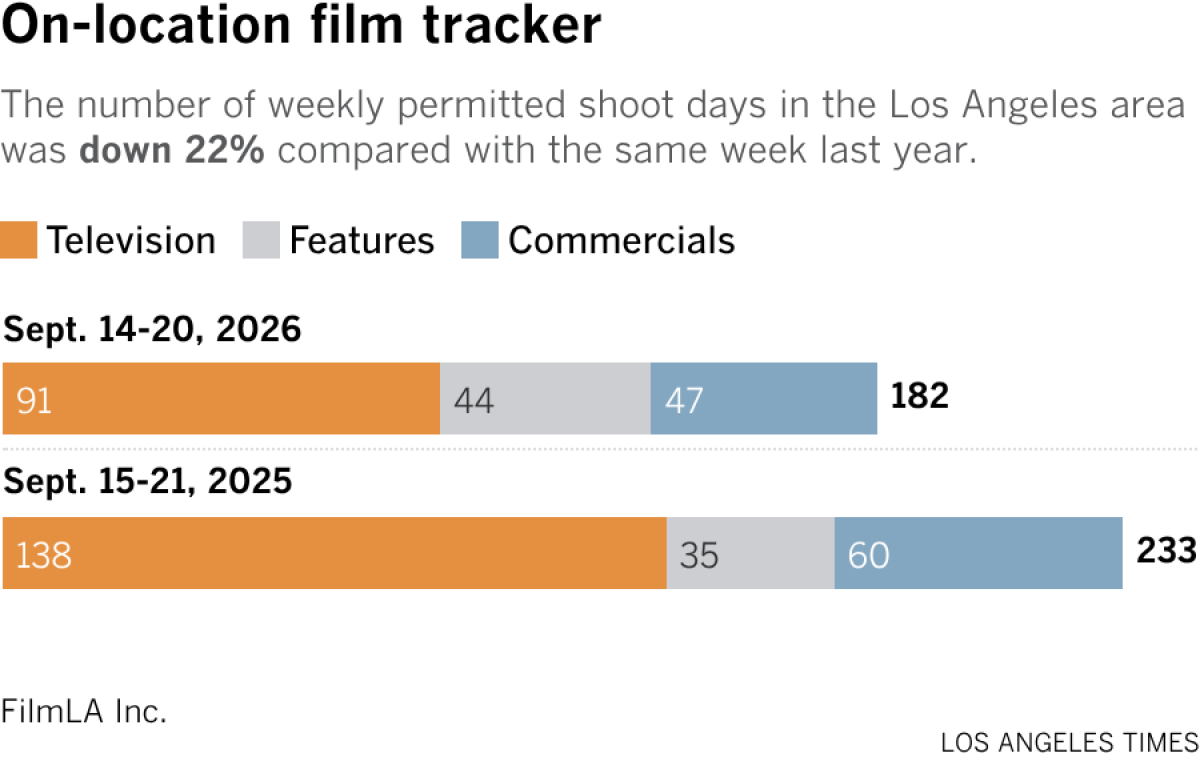
Film shoots

Number of the week

Zach Cregger’s much anticipated “Resident Evil” lived up to expectations. The well-reviewed horror film opened to $60 million in the U.S. and Canada over the weekend, topping the domestic box office and marking the “Weapons” and “Barbarian” director’s biggest career debut.
The Sony Pictures film is based on the video game franchise of the same name.
That’s more good news for the cinema business. So far this year, the domestic box office now stands at $7.64 billion, a 19% increase from the same time last year, according to Rentrak data.
What I’m watching
Now that college football season is upon us, it’s time for my annual optimism that UCLA is actually better this year. And after this past Saturday, maybe my hopes aren’t unrealistic after all. I watched the Bruins’ game against Purdue and despite some tough plays at the end, UCLA didn’t fold and is now 3-0. Go Bruins!