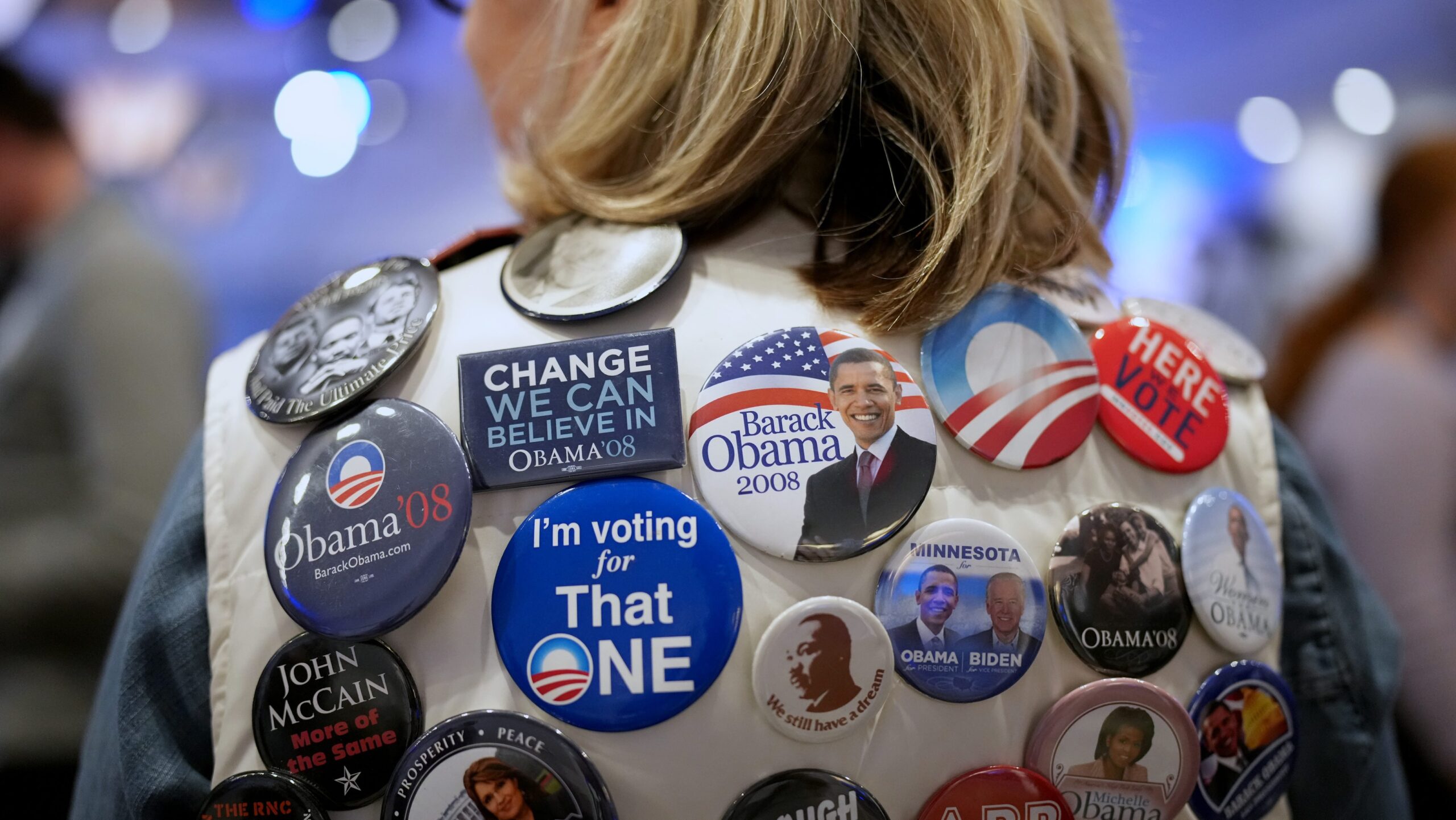
As election cycles ramp up in the U.S., voters project their political feelings in the form of campaign buttons, T-shirts and signs on front lawns.
What happens to these vestiges of campaigns, both failed and successful, after Election Day passes?
Some of these items inevitably end up in a landfill, but others could eventually become enshrined as relics of this consequential period in American history.
The Smithsonian’s National Museum of American History in Washington, D.C., has spent decades preserving the physical evidence of American political campaigns. Their collection consists of more than 100,000 objects, some dating back to the earliest American elections.
Campaign tools become artifacts
Smithsonian curators have described their work as a form of scavenging.
They root through conventions and other events in search of objects that capture a particular moment in time.
“We trawl through the place and pick things up, from signs that are left to signs they’re handing out,” curator Lisa Kathleen Graddy said in a 2024 Smithsonian interview.
The museum’s collection includes eccentric pieces like a giant pencil-shaped sign that bolstered a write-in campaign for Ralph Nader in 1988.
Another highlight of the Smithsonian’s collection proves that political gloating is not an exclusively modern phenomenon.
A banner from Thomas Jefferson’s 1801 inauguration features a portrait of Jefferson and an eagle hovering with ribbons above the president’s head. “T. Jefferson, President of the United States, John Adams is no more,” the ribbons read.
“We try to document, through material culture, Americans’ relationship with their democracy, with their government, how they are affected by it, how they affect it and how they interact with it,” Graddy said.
These objects help historians preserve and understand the candidates themselves, along with the surrounding cultural context, like political messages, trends and campaign strategies.
Could your old campaign merch be worth something?
While a campaign button from the 2026 midterm elections could seem trivial, holding onto ostensibly ordinary objects could pay off one day.
Even if it is not acquired by the Smithsonian, there is a thriving community of independent collectors who buy, sell and trade political memorabilia out of personal interest.
The American Political Items Collectors, a nonprofit organization that seeks to preserve political history, hosts conventions where enthusiasts can trade items like vintage buttons, posters and ribbons.
According to the organization’s president Tony Lee, an item’s value often depends more on its rarity than the relative fame of the politician. The lesser known candidate that history may have forgotten can sometimes be associated with highly sought after merchandise.
“Candidates who are fairly obscure like James Cox or John Davis – they were presidential nominees in the 1920s – their stuff is expensive because it’s rare. They didn’t make a lot of political items. Meanwhile, the Trump stuff is more like Beanie Babies. There’s no scarcity – they’ll make whatever is needed.” Lee said in a July interview with the Promotional Products Association International.
Because fewer products featuring obscure candidates were made, they can go for significant sums.
A particularly rare 1920 campaign button featuring James Cox and Franklin D. Roosevelt sold for $185,850 at auction, according to the organization.
Democrats’ victories in the 2026 midterm elections give them control of both the House and Senate. Here’s how that could lead to investigations, potential impeachment proceedings and major challenges for President Donald Trump’s agenda.
What happens to the leftovers?
Obviously, not every campaign sign or T-shirt is destined to become a collector’s item.
Some people may hold onto the political merchandise they may have received at a rally or bought from a campaign, but many others will be tossed, especially if a candidate loses.
Political merchandise can become a personal memento, even if it has limited market value at the moment. Even seemingly ordinary campaign objects can offer historians and collectors a vital window into the past.
Somewhere in the overflow of campaign merchandise from the 2026 midterms could be a hidden gem that future generations deem worth saving.