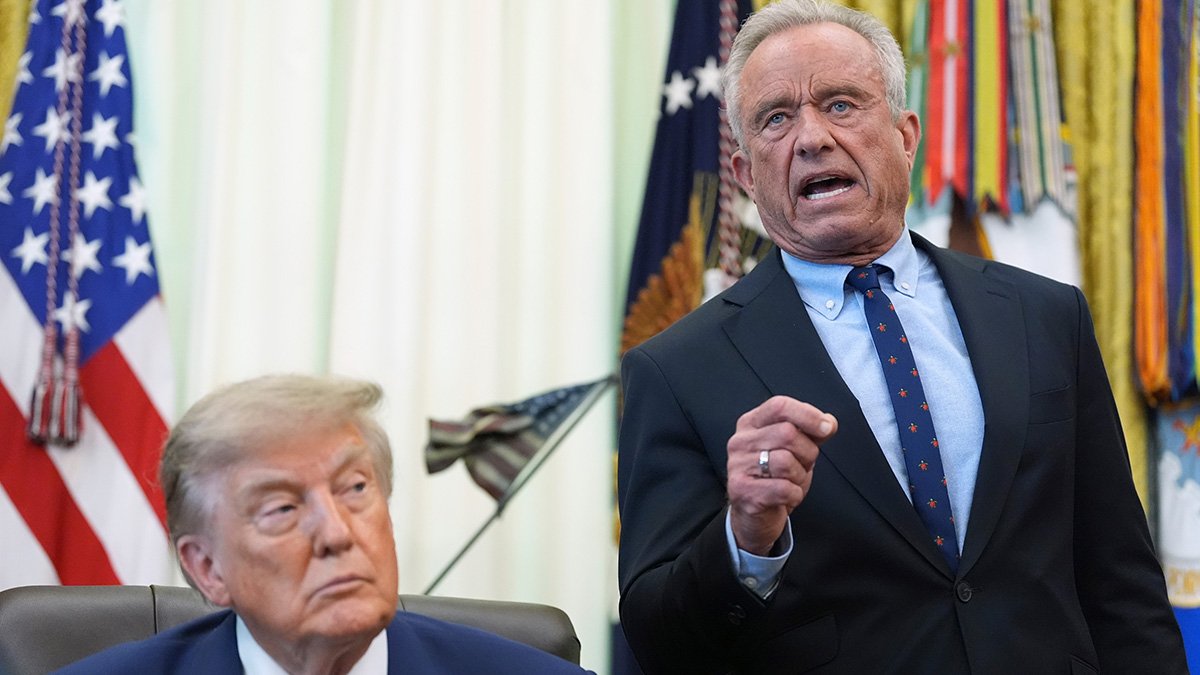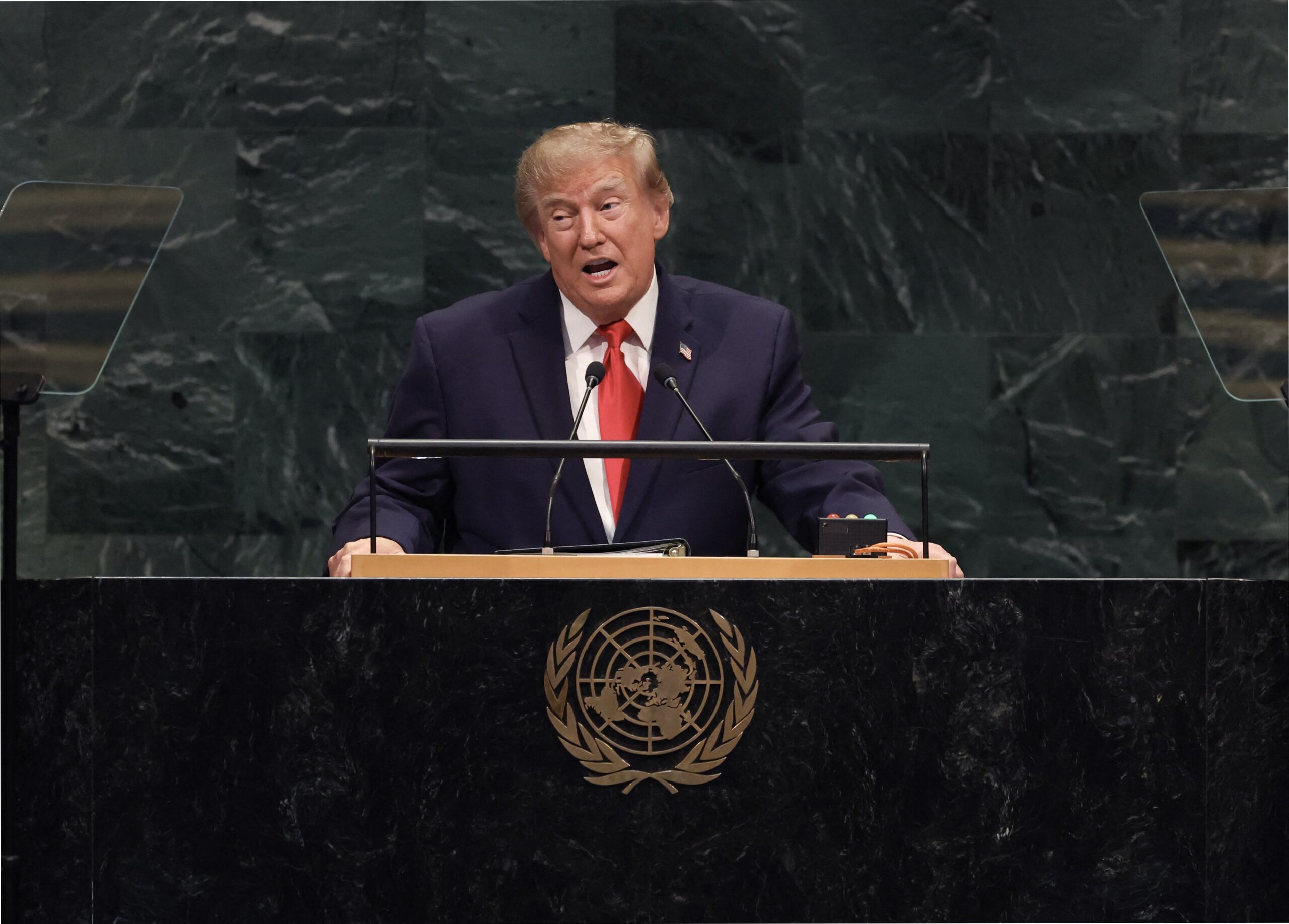
President Donald Trump addressed the U.N. General Assembly on Tuesday at a tumultuous moment for the world — and for his presidency — and made the case that he’s shown fortitude while other leaders have equivocated as he defended his decision to start a war with Iran.
Trump opened his remarks to the international community with more of a campaign stump-style speech, largely overlooking foreign affairs to focus on his domestic track record on the economy, immigration and crime.
“I can report to you with pride that America is back and our country is stronger today than ever before,” Trump said.
Trump then turned to his six-months-long war against Iran, framing the conflict he launched earlier this year as necessary to address a long-ignored threat. Trump accused Iran of stalling to make a deal to fully reopen the Strait of Hormuz and negotiate an endgame to the war until after the midterm elections.
“I have a big decision to make,” Trump said. “Will a deal be made with Iran that lets them rebuild and create a far greater country than it ever was before, maybe one of the greatest in the Middle East or even the world? Or do I annihilate the Islamic Republic and do it quickly, never giving them a chance to kill and destroy people and countries again?”
He continued, “Do I drive them into hell with no chance of survival and no hope of future greatness or generations?”
Iran’s delegation walked out as Trump railed against the Islamic Republic.
The president’s comments came in his wide-ranging address to the international body in which he also celebrated this year’s U.S. military operation to oust Venezuelan President Nicolás Maduro from power, a new agreement to expand the U.S. military presence in Greenland, and pushed back against calls for greater regulation of the artificial intelligence industry.
The visit to the U.N. comes when Trump’s foreign policy approach — particularly his decision to start a war with Iran — has become a drag on his fellow Republicans’ hopes of retaining control of both chambers of Congress during the coming midterm elections. Recent polls show 69% of Americans disapprove of Trump’s handling of the war. Trump insisted Tuesday that he’s not concerned with politics and claimed the world is better off for his leadership.
“As president of the most extraordinary nation in history,” Trump said. “I have no interest in leaving dangers to grow for another day. I do not believe in letting problems fester.”
The global economy has been shaken by his decision to launch a war against Iran. Anxiety about the social impact being wrought by artificial intelligence is surging. And questions linger about the future of the United Nations itself with Trump’s scaling back U.S. financial support for the United Nations.
Trump’s speech began a busy day of diplomacy
After his speech, Trump gathered with Danish Prime Minister Mette Frederiksen and Greenlandic Prime Minister Jens-Frederik Nielsen on the sidelines of the General Assembly to sign a new security agreement.
The deal, announced last week, came together after Trump repeatedly threatened to “take over” Greenland, a territory of NATO-ally Denmark, by military force if necessary. Trump said Tuesday the U.S. will immediately begin the process of developing a larger military presence in Greenland including “building two very major military bases.”
Under the deal, Greenland remains Denmark’s territory.
“This deal is good for the United States, it’s good for Greenland, Denmark, for the NATO alliance and therefore also good for Europe,” Danish Prime Minister Mette Frederiksen said in remarks before leaders from the three countries signed it.
Trump also held talks with new British Prime Minister Andy Burnham. The leaders said they discussed migration, the conflict in Iran, the Russia-Ukraine war and more.
Trump also met with Japanese Prime Minister Sanae Takaichi. Later, he’ll meet with Ukrainian President Volodymyr Zelenskyy, and will hold a more informal meeting with Venezuela’s acting President Delcy Rodríguez, according to the White House.
He’s also set to meet with leaders and senior officials from Gulf Cooperation Council nations — Bahrain, Kuwait, Oman, Qatar, Saudi Arabia, and United Arab Emirates — to discuss the way ahead with the war in Iran and growing concern about recent Iran-backed rebel attacks on Saudi Arabia. Trump also plans to take part in an event on the Shield of Americas, an initiative Trump launched with Latin American countries earlier this year focused on combatting violent cartels.
Iran war looms large
In last year’s address at the U.N., Trump claimed the U.S. had “demolished” Iran’s nuclear capabilities after he ordered the June 2025 bombardment of three key facilities.
He returns to the General Assembly nearing the seven-month mark of a new war against Iran that he insists is necessary to address a nuclear threat posed by Iran.
The war has grown more complicated even though strikes by the United States and Israel have killed much of Iran’s top leadership and destroyed its air force and navy, while a U.S. blockade of Iranian oil has left Tehran in economic shambles.
The energy market continues to be spooked by the war and oil prices remain elevated. Saudi Arabia earlier this month shuttered a key pipeline that acted as a relief valve for oil blocked in the Gulf. The kingdom made the move after the pipeline came under attack by Iran-backed militants in Iraq.
At the same time, territorial grabs by the Yemen-based Houthi rebels, another Iranian-backed group, near the Bab al-Mandab Strait has now made it treacherous for oil carriers to use that Red Sea shipping lane.
But Trump insisted anew that the elevated oil prices are a transitory problem that will fade one the war ends.
“Oil prices will come plummeting down even lower than they were at the start of the conflict,” Trump said. “And they were very low in the United States. They were really low.”
Secretary of State Marco Rubio said on Tuesday that Trump is open to meeting with Iran’s president, Masoud Pezeshkian, while he’s in New York for the General Assembly.
“This is a president that will meet with anybody for the most part, because he believes that engaging with people is important if you’re going to solve problems,” Rubio said on the “TODAY” show. “It doesn’t mean you’re going to end up agreeing with them, but it’s important.”
Trump’s frustration with Russia-Ukraine war mounts
Trump also touched on Russia’s continuing war against Ukraine during the address — a conflict that during his 2024 campaign he predicted would be resolved on Day One of his second term. He once again expressed hope that the conflict will soon be resolved.
“We’re working very closely with the leaders of Russia and Ukraine, and we will get that one done,” Trump said. “It’s going to happen, I think, more quickly than people understand.”
The war began in early 2022 with Russia’s invasion of Ukraine. Trump has repeatedly suggested peace was at hand since returning to the White House in 2025, only for the conflict to continue.
The president has routinely expressed frustration about the conflict. He hasn’t obscured that his patience is being tested by Ukraine’s targeting of Russia’s diesel refineries — an issue that’s added to oil markets’ volatility — and Russia’s targeting of Ukraine’s energy grid.
Trump last week asserted that he got the two sides to agree to not target each other’s energy infrastructure.
Ukrainian President Volodymyr Zelenskyy, who is scheduled to meet with Trump on Tuesday afternoon, said he was willing to go along with Trump’s plan if Russia abided by it. Russia said it could only go along with Trump’s energy truce proposal if Western energy sanctions on Moscow were lifted first.
The two sides have continued carrying out strikes on refineries and other energy infrastructure. Trump on Monday, before departing for New York, expressed his frustration with targeting of energy infrastructure.
“Russia has unfortunately lost control of its Diesel Oil Industry due to its War with Ukraine,” Trump posted on social media. He added, “This ridiculous and never ending War with Ukraine must be ended.”