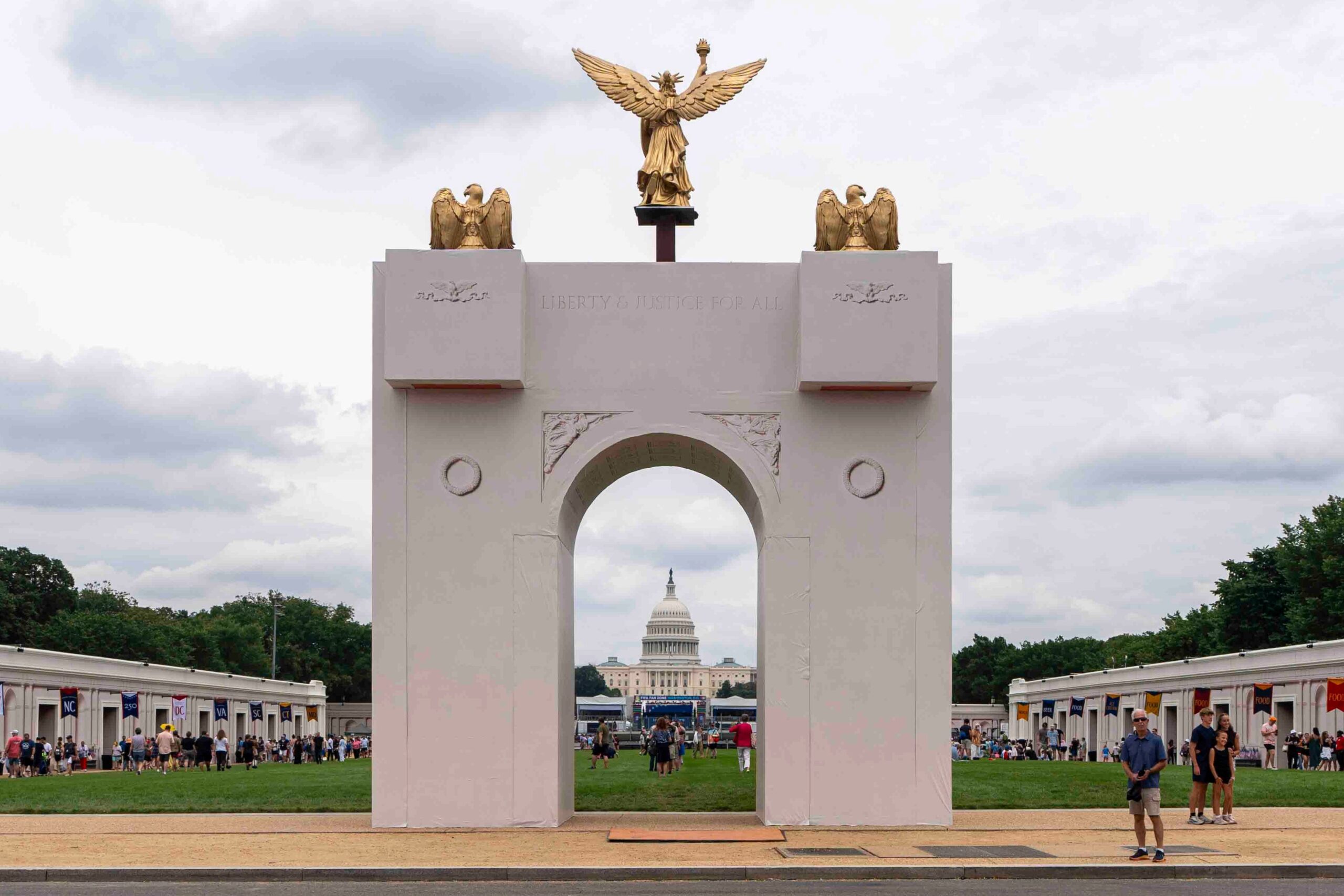
President Donald Trump said Sunday that the massive arch he wants to build between the Lincoln Memorial and Arlington National Cemetery would become a “top grade military complex” able to host drones and snipers while storing ammunition.
It is one more example of how Trump is insisting that his initiatives to beautify the White House and the city are also serving a defense purpose. Trump has been calling the new White House ballroom a “military complex” and arguing it is necessary for national security purposes.
The Pentagon said it had no information beyond the president’s statement.
“I have to admit, I’m a little skeptical based on his track record,” resident Doug Mueller told News4 on Sunday. “It seems to me like if we did need counter-drone technology or additional defenses along those lines, there would be better ways to do it.”
Trump’s announcement also comes as the arch, like his other projects, faces legal challenges. Though the arch has received early approval from the U.S. Commission of Fine Arts, whose members were all tapped by Trump, a group of three veterans and an architectural historian sued, saying the project needs to be approved by Congress.
“The President’s belated efforts to manufacture a national security justification for this project do nothing to cure its fundamental illegality,” Nicolas Sansone, one of the attorneys representing the litigants, said Sunday. “Congress has not authorized the arch and unless and until Congress does so, the project should not be permitted to move forward.”
The Republican president said in a social media post that he had agreed, at the “strong request” of the military, to convert the planned 250-foot-tall (76-meter) memorial arch “into a top grade Military Complex/Triumphal Arch, to house, store, and have the rapid ability to use large numbers of drones, plus Snipers, on both the roof and plaza areas, and additionally have and hold large quantities of sniper ammunition in storage.”
The arch is proposed for a circle adjacent to the Memorial Bridge, which is a heavy traffic area as one of a handful of connecting bridges between the nation’s capital and northern Virginia.
The project is one of several projects that the Republican president is pursuing to leave his lasting imprint on Washington. Among the others are the White House ballroom, renaming and renovating the Kennedy Center, refurbishing the Lincoln Memorial Reflecting Pool and rebuilding a golf course in East Potomac Park that could significantly reduce the public’s access to running and biking paths.
The groundbreaking for the arch was to have happened sometime this month. The project has not yet received final approval from the National Capital Area Planning Commission, which greenlit the site and preliminary plans at its July meeting. The commission is expected to take up the matter again this fall.
“I like to come to Arlington Cemetery and visit Medgar Evers’ grave,” Mueller said. “He’s a civil rights hero that I’ve been impressed with, gave up his life for what he believed in, and now when I come and am with Medgar Evers’ grave, I’ll be looking at this triumphal arch.”
Opposition to the arch was also on display Friday, with protesters raising concerns about its size, location and potential impact on the historic landscape. The National Park Service in August released a report detailing nearly 40 sites across the district that the arch would “adversely impact.”
Also on Friday, the Federal Aviation Administration determined the structure would not pose a hazard to aircraft but said it would need lighting to make it visible to pilots.
In a statement, Virginia Rep. Don Beyer said, “Putting a drone launching site directly in the landing path for DCA is a stupid, dangerous, and unworkable idea.”
The project is also facing a federal lawsuit brought by three Vietnam War veterans and an architectural historian.
The National Park Service and Department of Defense did not respond to requests for comment Sunday. For now, the project still faces additional federal review.