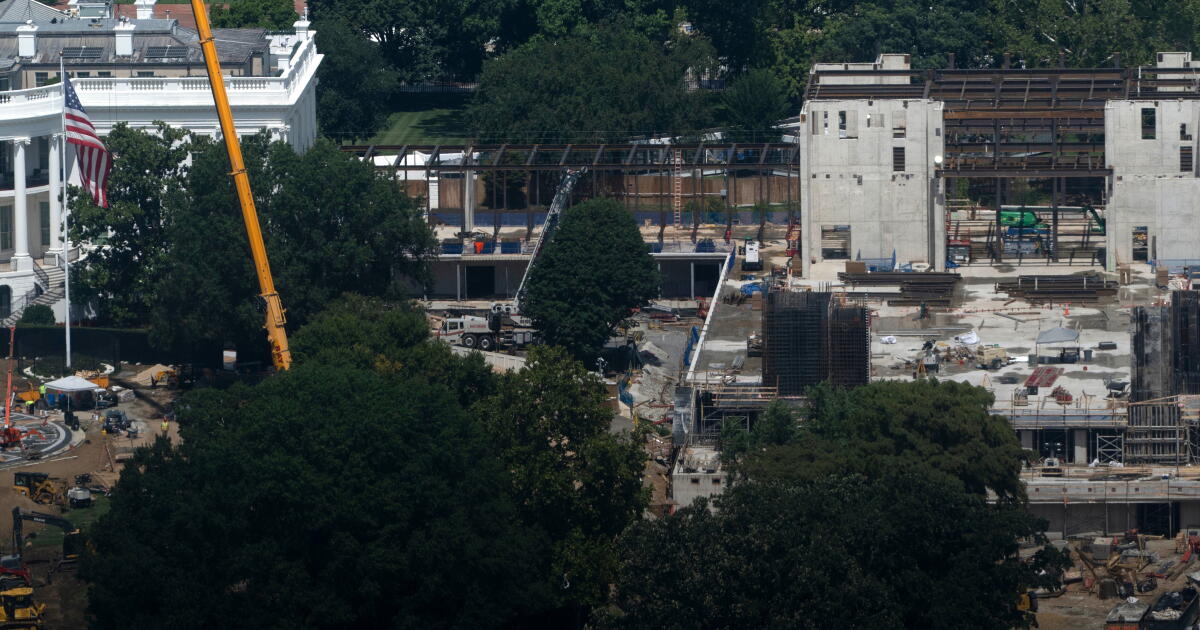
WASHINGTON — A divided Supreme Court has cleared the way for President Trump to finish building his new White House ballroom with mostly private money and without approval from Congress.
By a 5-4 vote, the justices granted an emergency appeal from Trump and his lawyers on Monday, setting aside a judge’s order that would stop the construction.
But Chief Justice John G. Roberts Jr. dissented, along with the court’s three liberals.
Roberts said the construction project was “likely unlawful” and should not be allowed to continue.
“The White House is not just any building … when it comes to historic preservation,” Roberts wrote. “Winston Churchill once remarked that ‘[w]e shape our buildings, and afterwards our buildings shape us.’ All the more reason to ensure that those responsible follow the rules in deciding what to tear down and what to build up at the People’s House.”
The outcome turned on the standing of the plaintiffs, the National Trust for Historic Preservation and its members.
The conservative majority pointed to Alison Hoagland, one of its members, who said she lives in Washington, walks by the White House about once a month and said she found the “scale,” “height” and “massing” of the huge ballroom to be distasteful.
“This court has not found standing in circumstances like these before. To the contrary, we have repeatedly held that mere offense, disagreement, or distaste does not qualify as a concrete and particularized injury,” the unsigned order said.
It is a major victory for Trump, whose ballroom project has become a signature effort of his second term and a political lightning rod in Washington, where Republicans have refused to fund it with public money.
Trump celebrated the victory with a post on social media, declaring the venue would now be built “without any further contingency, doubt, or threat.”
“We are living in the Golden Age of America, and this Building will be one of the Greatest ever constructed in Washington, D.C.,” Trump wrote. “When completed in the Summer of 2028, the magnificent Ballroom and Military Complex will be something that the entire Country is very proud of.”
The massive new structure, set to dwarf the historic White House mansion, is the president’s singular vision — one of a string of aesthetic projects Trump has pursued in a feverish effort to cement his legacy by putting his personal stamp on the nation’s capital.
But preservationists and architects have criticized the proposed ballroom as a garish, rushed project that ignored the input of experts. The president has personally overruled his own chosen architects after being told the building would overwhelm the executive complex.
Democrats have seized on the president’s fixation on the ballroom as a symbol of vanity and detachment from the concerns of everyday Americans heading into November’s midterm elections.
According to recent polls, a bipartisan majority of voters disapprove of the president’s handling of the economy and say the country is facing an affordability crisis. The ballroom is projected to cost more than $400 million, excluding the undisclosed cost of underground security upgrades.
Trump’s three appointees — Justices Neil M. Gorsuch, Brett M. Kavanaugh and Amy Coney Barrett — joined conservative Justices Clarence Thomas and Samuel A. Alito in an unsigned opinion ruling for the president.
The conservative majority also said Trump and his appointees had stressed the new ballroom was needed for national security and said the lower courts judges should not have interfered.
Administration officials have argued that an underground “integrated military complex” was the heart of the project and that the ballroom would merely be sit top of the facility “vitally required by national security.”
The decision is not a final ruling, but it gives a green light to Trump’s go-it-alone approach, which is in keeping with his history as a hotel builder.
He believed the White House needed a grand ballroom that could seat hundreds of dignitaries. Acting on his own, he ordered the East Wing torn down in October to make room of his larger ballroom.
He also said most of the project would be paid for by private donations.
But the Constitution gave Congress the power to manage property belonging to the United States. A 1912 law says new buildings “shall not erected … on public grounds within the District of Columbia without express authority of Congress.”
Trump chose to ignore the law and did not seek approval from Congress, which is led by Republicans.
The National Trust for Historic Preservation sued in December, contending Trump was a “temporary tenant, not the owner” of the White House.
U.S. District Judge Richard Leon ruled Trump had no authority to build a ballroom on the White House grounds without the approval of Congress, and he ordered a halt to the above-ground construction.
The District of Columbia Circuit Court affirmed his decision by a 2-1 vote.
“Congress has not ceded unfettered authority to the Executive Branch to dramatically redesign, reshape, and reconstruct the White House — the People’s House — to fit a particular President’s desires,” wrote Judge Patricia Millett for the appeals court.
Trump’s lawyers sent a fast-track appeal to the Supreme Court on Aug. 14.
The court’s majority allowed Trump to fend off the legal challenge by concluding the historic preservationists could not show they were harmed by the huge new ballroom.