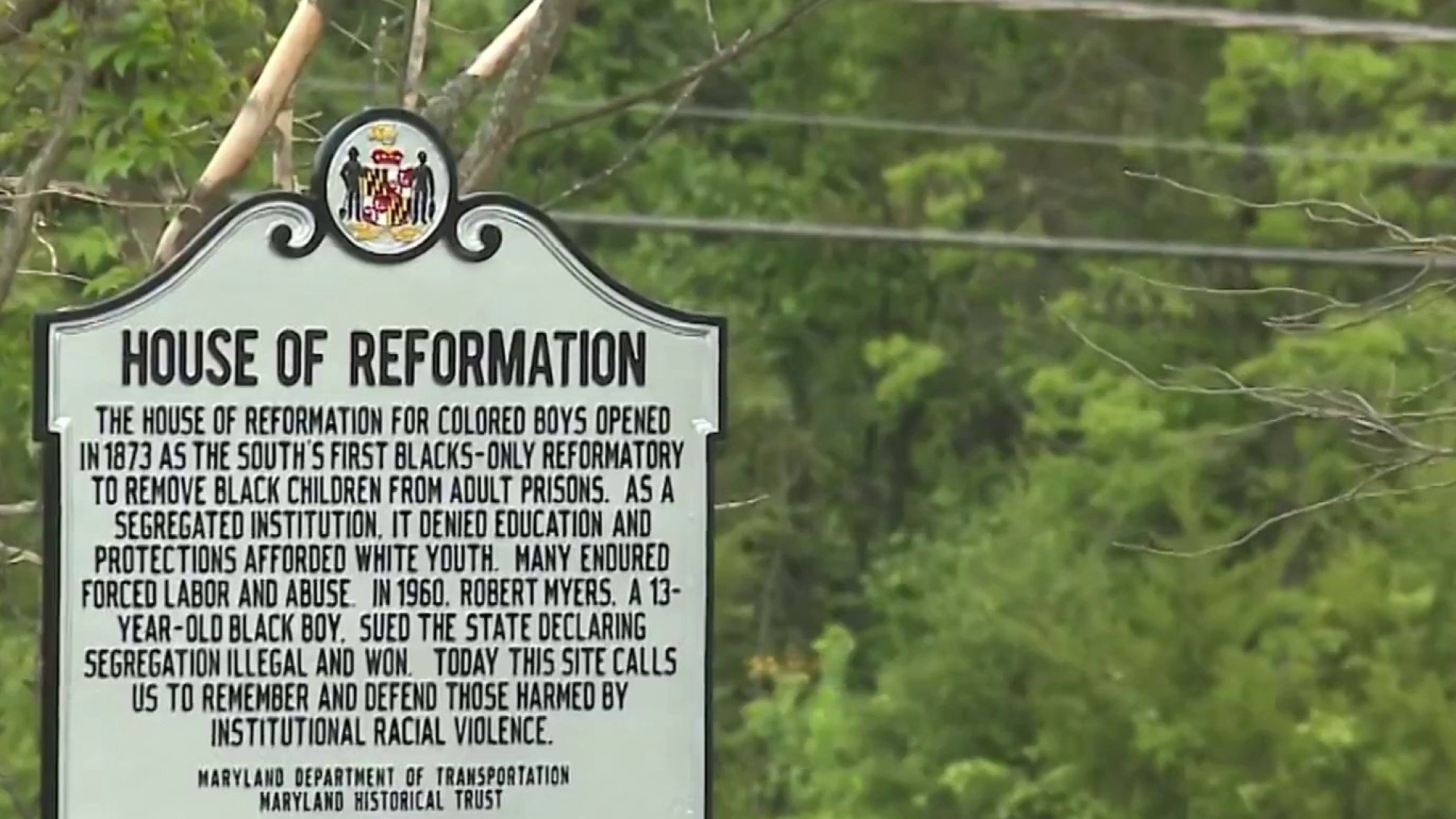
A commission formed to study how hundreds of Black youth died at a former state-run juvenile detention facility in Prince George’s County held its first meeting this week.
The Maryland General Assembly passed legislation this year creating the House of Reformation Commission to study how boys who were in state care died and were buried in unmarked graves at the former Boys Village site in Cheltenham.
Commissioner Phyllis Hammond learned in April her uncle, Amos Hammond, was buried at 18 years old in the long-forgotten graveyard. Only a cinderblock marked his grave.
“It’s heart-wrenching,” she said. “They didn’t grow up easy. I think that’s why my father never talked about his family.”
The graveyard in Cheltenham is at the site of the former House of Reformation, a segregated, state-run facility for boys dating to the 1800s. Some headstones are in disrepair, and many of the graves appear to be unmarked.
Hammond’s death certificate shows he died at the House of Reformation in 1921 of acute peritonitis, which can lead to a life-threatening infection.
“They try to have a good reasoning for most of the deaths that happened there,” Phyllis Hammond said. “And, you know, questionable, very questionable as to how these young men died. And especially when you’re looking at over 300 and some young men.”
She described how she felt after visiting the graveyard for the first time.
“Gut wrenching,” Hammond said. “I cried.”
It inspired her to act. The commission on which she sits will make recommendations to the governor.
Hammond wants to be a voice for the families.
“Make that site a memorial, a place of dignity to recognize these young men, to bring awareness to the lives that they lived in that facility and how they died in those woods,” she said.
Maryland Attorney General Anthony Brown chairs the commission.
“They were beaten … forced to labor,” he said at the commission’s first meeting. “They were denied an education. They were malnourished and medically neglected.”
Among the questions facing the commission:
- Should the bodies be exhumed?
- Should the graves be left alone?
- Should families be able to move remains to other burial sites?
“I’m grateful to be on this journey,” Hammond said. “It’s not going to be an easy journey. It hasn’t been. I’m still grieving; all the families are still grieving. But I’m just so thankful that this has been revealed.”
She wrote a poem inspired by the discovery: “If These Woods Could Talk.”
“I just wonder sometimes, if those woods could talk, how many lives could have been saved?”
The commission expects to release an initial report by the end of next year.