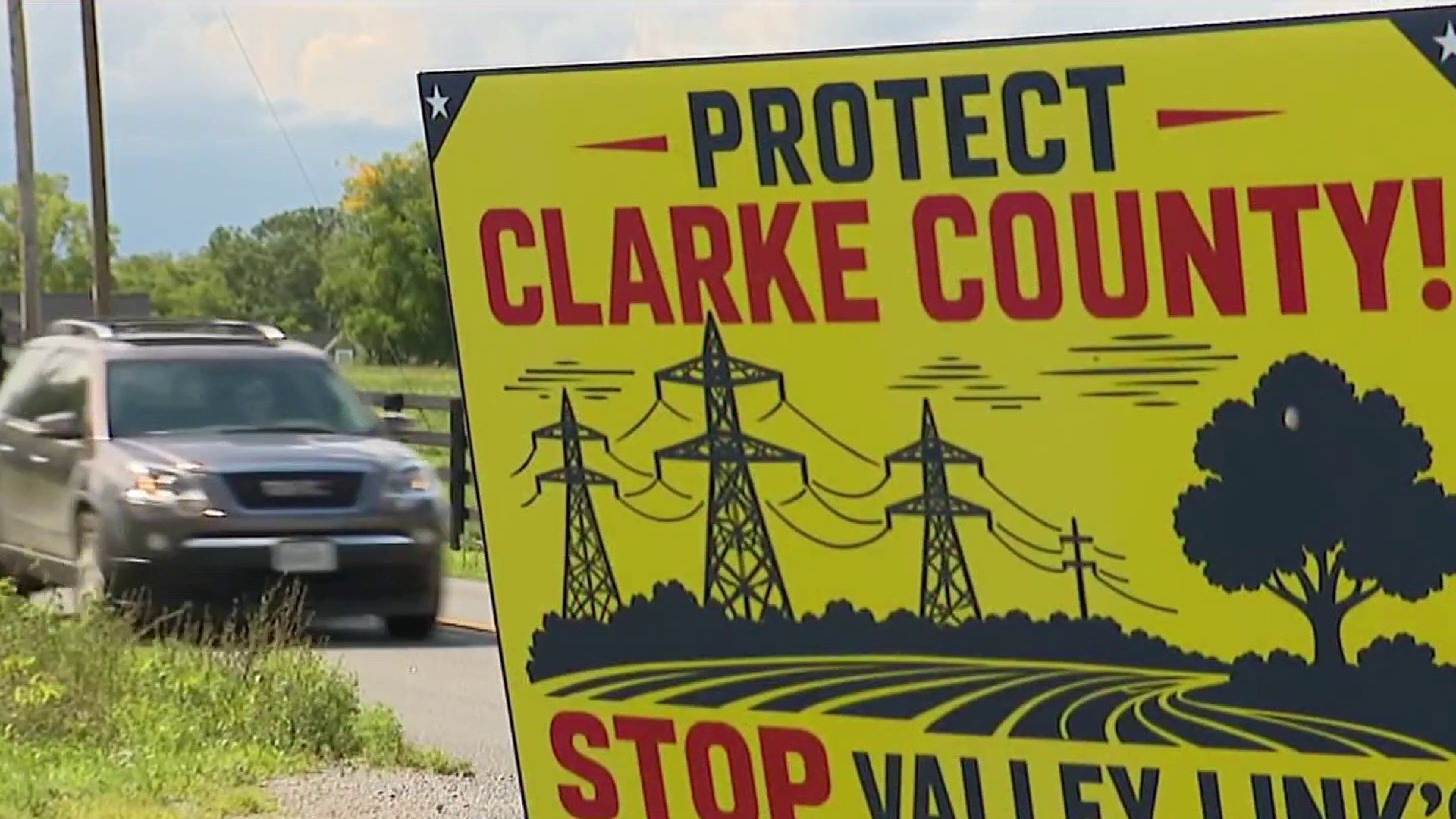
Communities throughout the region are fighting back against a massive, high-voltage transmission line project that could crosscut historic farms, cemeteries, neighborhoods and rivers, which residents say would ruin their community.
The Valley North Project, which carves across three states and 25 counties, is a joint venture of Dominion Energy and two other utility companies that say it is needed to support new industries, technology and population needs. It would be the most powerful transmission line permitted by law.
On a farm two years older than the nation, Bevin Lewis isn’t ready to say goodbye to the farm that’s been in her family for eight generations. Her husband Mark’s grave is nearby.
“He was my person,” she said.
She sits by his grave daily but worries those days are numbered because one of the proposed routes for the transmission line is too close.
“Right over top,” Lewis said. “They’re going right over where I just buried my husband, and I mean, literally this is going to make it so we can’t live here anymore.”
According to a Valley North promo video, the 765-kilovolt transmission line — which is the highest voltage line allowed in the U.S. — would run about 260 miles from Putnam County, West Virginia, to Frederick County, Maryland, using eminent domain to carve a 200-foot-wide path.
There are three proposed paths, and one through Clarke County would run near the elementary school, the high school and “our soccer fields, our football fields, our baseball fields,” Valley North opponent Julie Baniowski said.
“Where my grandchildren play soccer,” she added.
Several county governments in West Virginia voted to formally state their opposition to the project. In a unanimous vote, the Clarke County Board of Supervisors recently did the same.
“This project is an example of how rural America bears the brunt of bad planning in urban areas,” Board Chair David Weiss said at a recent meeting.
In a statement to News4, a spokesperson for the Valley North Project said, in part, “Our existing grid is being pushed closer to its limits. Without additional capacity, the risk of service interruptions, voltage issues and even broader outages increases over time.”
Local attorney Zelicia Read is helping with the grassroots opposition.
“If it’s actually running over your property, that is where you’ll get some level of compensation, but if you’re on an adjoining parcel, guess what? It’s gonna devalue yours, too, and you get nothing,” she said.
Homeowners have very little legal standing against a major corporation, Read said.
The project proposal is in the public information stage and will be presented to state regulators for approval next year.
“I have cried so many tears thinking about that,” Lewis said. “I’m literally losing my life, my lifestyle, the future that we knew we had, that we’ve protected for 252 years. It’ll be gone because of this.”
Experts said the explosion of data center growth and artificial intelligence computing capacity has exposed the fragility of the electrical grid. In the race to keep the lights on, neighbors fear the plans and decisions are being rushed at the expense of people who don’t feel they have a fighting chance against massive corporations, which are allowed, by law, to build right through property.
The public comment period for the Valley North Project closes Friday.