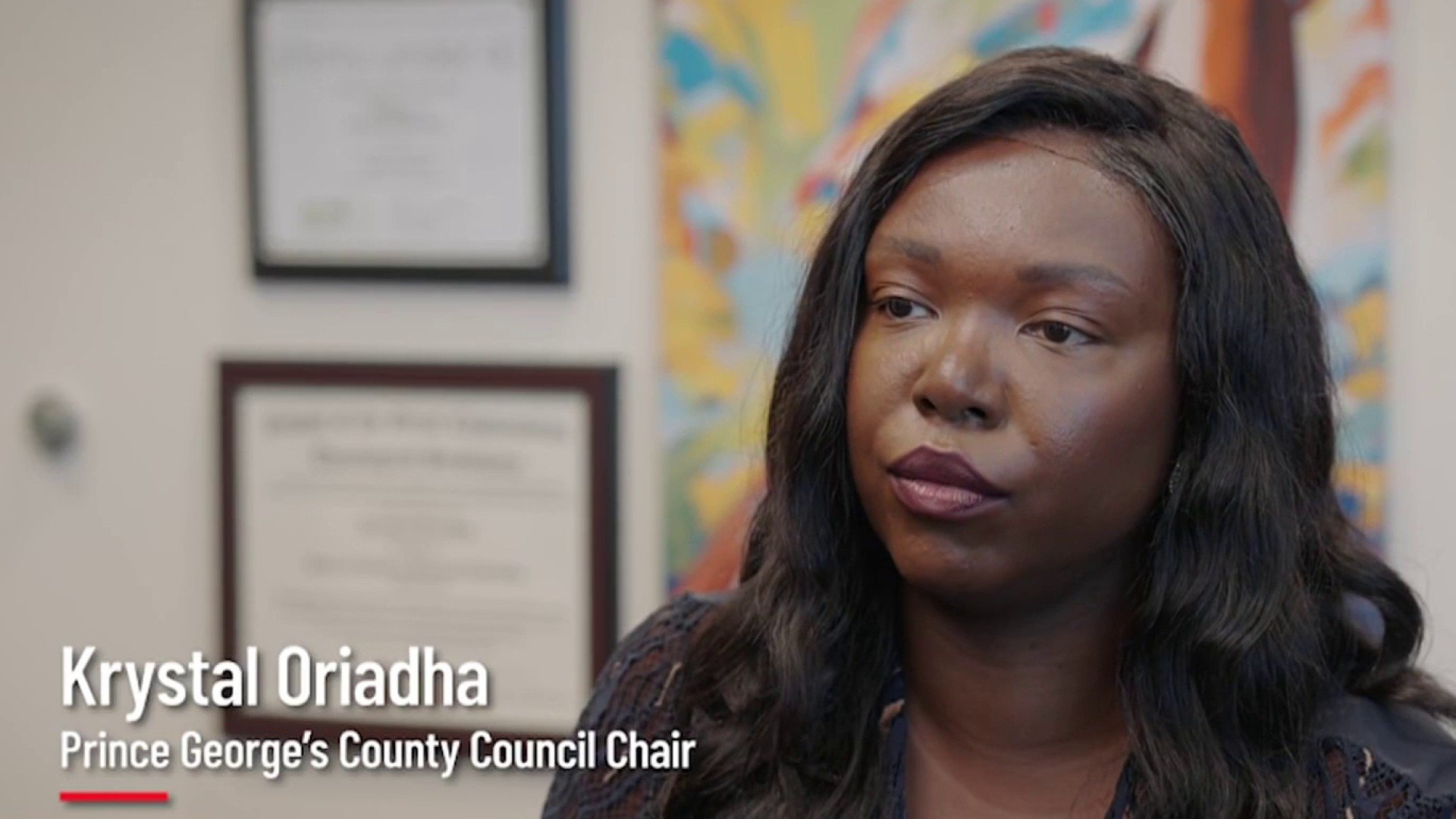
In defending her decision to award millions of dollars to an organization she acknowledges is run by a friend, Prince George’s County Council Chair Krystal Oriadha said the council followed every step in its grant-making process.
“I want everyone to know that the process was fair, that it was transparent, that we did not break any rules,” she said in a recent interview with the News4 I-Team.
But concerns raised by a former staffer, along with grant documents News4 obtained through an open records request, raise new questions about the council’s process before awarding nearly $8.6 million to the Edward Charles Foundation in two payments earlier this year.
A Prince George’s County judge agreed to postpone hearings in a $39 million battle between the Maryland National Capital Park and Planning Commission and the county. Investigative reporter Tracee Wilkins explains.
The California-based foundation is the fiscal sponsor of Community on the Frontline, a local organization run by Janna Parker, whom Oriadha has called on social media her best friend. In October, the foundation returned most of those funds at the request of Oriadha and County Executive Aisha Braveboy.
Last month, Oriadha’s former deputy chief of staff publicly voiced concerns about his time working in her office in 2025, citing her closeness to Parker.
“In my first conversation with Janna Parker — we refer to her as Parker, not Janna — she said to me: ‘Darrell, I don’t know if you know how this works, but Krystal tells me what to do and I cut the check.’”
Parker, nor the Edward Charles Foundation, responded to the I-Team’s requests for comment on this story.
Darrell Robinson Jr. told the I-Team it was his job to write scopes of work for the organizations Oriadha wanted to receive grants – something he said he worried gave those organizations an unfair advantage.
“They were supposed to take the scopes that were drafted by me and other members of the team in the office, and submit those to the county for those funds,” he said.
Robinson resigned after about three months on the job in May 2025 and said he filed an ethics complaint documenting his concerns with grant management in the office. The county denied the I-Team’s open records request for a copy of the complaint and any resulting investigation.
After another former staffer confirmed Robinson’s account of writing scopes of work, News4 asked Oriadha about his allegations.
“That’s just fundamentally not true,” she said.
Oriadha said she encourages her staff to help applicants understand the process, which may include meeting with them or providing samples of scopes of work.
“But whatever the project is, it happens in a meeting that we agreed to. We don’t just write the scopes for them and say, ‘Just apply for this.’ That’s not how it works,” she said.
David Williams, head of the nonprofit Taxpayers Protection Alliance, said Robinson’s allegations raise questions about fairness within the council’s grants process.
“That’s why this process has to be open, has to be taken out of political hands and put into an independent agency or commission, so they can decide who’s the best nonprofit to spend the money,” he said.
Application questions
Applications that Community on the Frontline submitted before receiving the roughly $8.6 million in grants raise questions about Oriadha and the council’s process in awarding the funds.
Documents show that on Jan. 9, Parker submitted an application to the council’s grants management system, requesting $1.5 million for the Edward Charles Foundation and Community on the Frontline.
The I-Team found the application was reviewed and processed by the finance office on the same day Parker officially applied. Emails obtained through an open records request also show that four days earlier, the council staff had already earmarked $925,000 for the organization.
According to the council’s grants policy, “once an application is submitted,” it can take up to four to six weeks for review and processing.
Asked why this application was processed more quickly, Oriadha said in a written statement: “The January 9, 2026 date on the grant processing form should not be confused with the date work on the application began or the date funding was disbursed. Grant applications can involve weeks of preparation, communication, document collection, and review before the completed application is formally recorded as processed.”
News4 also examined an application Parker submitted in early May that led to the multimillion dollar grant award.
Under the line asking for the amount of her request, Parker stated: $0.0.
Roughly 10 days later, documents show the organization was approved for $7.635 million.
Oriadha has said Community on the Frontline was to serve as an “anchor” organization that would distribute that money to other organizations in the area.
“They’re the ones that are in the community helping do the program work, helping to do the coordination with additional nonprofits,” Oriadha told News4.
Asked by News4 how Community on the Frontline would decide which organizations to fund, Oriadha pointed to the council’s fiscal year 2026 budget that named organizations eligible to receive funds called “project charges” from the Maryland National Capital Park and Planning Commission. The county and commission are now in a lawsuit over control of these dollars.
“It was always transparent that those were the organizations that were going to get funded,” she told News4.
When the I-Team checked Community on the Frontline’s application in the council’s grants management system, there was no mention of the word “anchor” or similar language.
Instead, in the area of the application where Parker was asked to state the proposed use of the money, she wrote in part: “The needs of the community are wide ranging and focus on direct needs and programmic supports” and “The programming will be implemented through a continuation of the programming being completed within the county.”
In response to News4’s open records request for grant documents, the county provided a document called a scope of work. It’s not dated and doesn’t say who wrote it, but in her written statement, Oriadha said that scope of work is what the office reviewed as part of the application package.
“The application should be reviewed together with its supporting scope of work, rather than treating the brief narrative field as the complete description of the proposed program. The accompanying scope of work expressly identified COTFL’s role as an anchor organization and provided the more detailed explanation of how the funding would support community services,” Oriadha said in the statement.
A county spokeswoman confirmed for the I-Team that one of the organizations listed on that scope of work – The StoreHouse – did receive some of the $925,000 grant given to Community on the Frontline earlier this year and is now operating a free grocery store and food pantry in the county.
In an email, a spokesperson for The StoreHouse confirmed to the I-Team that it has received a $95,000 stipend from Community on the Frontline for that effort.
Prince George’s County confirmed a county auditor 6-1 Monday after Council Chair Krystal Oriadha called a special meeting with less than an hour’s notice to the public and her colleagues. Investigative reporter Tracee Wilkins reports one council member raised concerns about his possible ties to another elected official.
Family ties
All of these actions, the I-Team found, came under the purview of Director of Grants Shannon Rogers, who according to multiple county government sources was hired last year and is related to Oriadha through marriage.
“She’s related to my husband,” Oriadha confirmed when asked by News4, later clarifying in a statement to News4 that Rogers is a “distant blood relative” of her husband.
Oriadha said she was not involved in Rogers’ hiring.
“I don’t make decisions on the admin side about hiring,” she said, adding: “I did not recommend her. And then all of the grants are managed by council members in the sense of who approves them. Council members have all the control on who gets funded and who does not get funded.”
The county’s nepotism clause defines family as spouse, child, parent, grandparent, grandchild, brother, sister, brother- or sister-in-law, mother- or father-in-law, or son- or daughter-in-law – which would not include Rogers, who is a distant cousin by marriage.
Still, Williams, of the Taxpayers Protection Alliance, said familial relationships warrant extra scrutiny.
“Whenever you see a family connection, whether it’s through marriage or otherwise, it should raise red flags that something could go wrong in that process. Not that something has gone wrong, but there needs to be even greater scrutiny when you have people that are either married or related to someone that has control of the money,” he said.
District 8 Councilman Ed Burroughs – whose grants and use of project charges have also faced scrutiny – confirmed that his aunt, Kim Jenkins, also was hired to work in the grants office under Rogers. He also said Jenkins no longer works in that office.
Rogers declined comment for this report. Jenkins could not be reached for comment.
An audit of a Prince George’s County nonprofit with close ties to Councilmember Ed Burroughs was supposed to be presented at a meeting Tuesday, but an official said it wasn’t ready. Supporters spoke and councilmembers who called for the audit said their microphones were cut. News4’s Darcy Spencer reports.
Looking ahead
Oriadha said she welcomed the return of the money to Prince George’s County so that she can prove it was not used improperly. She said that, if voters aren’t happy with the grant-funding decisions she’s made, they have the power to vote her out of office.
“If at the end of the day, they don’t believe that I fought hard for my district, if they don’t believe that I got programming and resources, if they don’t like the policies that I champion, they have the decision to say, ‘No, we’re not going to send her back,’” said Oriadha, who easily won re-election earlier this month.
Williams, the taxpayer watchdog, countered: “It’s not just about elections. It’s about making sure on a day-to-day, month-to-month, year-to-year basis that this money is being spent wisely.”
Robinson, the former staffer, said he believes the council’s grants process deserves more scrutiny.
“There are people in that community who have a pulse on what that community needs, and they should have had a fair shot in getting those dollars to serve people that they’re connected to. And they didn’t,” he said.
A flag is a powerful symbol that can open the door to conversations that are tough to have. Now there’s a flag that represents the Black maternal health crisis in America. News4’s Jummy Olabanji speaks with artist Lex Marie about her work.