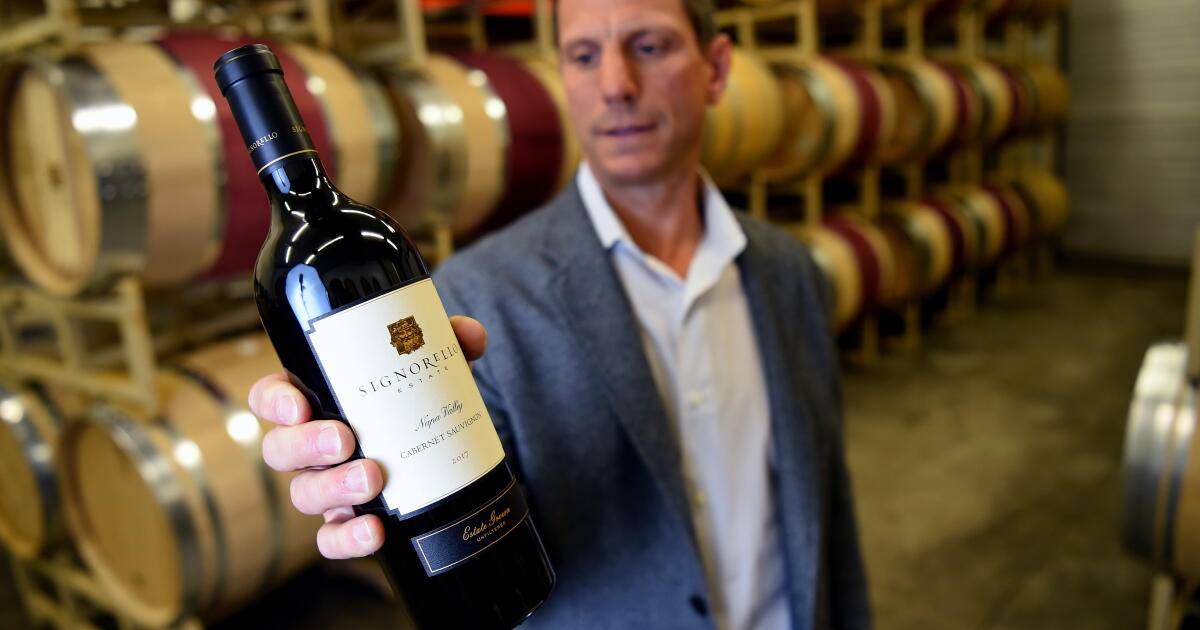
Another iconic California winemaker is having money troubles.
Signorello Estate — a Napa Valley winery that rebuilt after becoming the poster child of the Atlas fire when its tasting room burned to the ground — filed for Chapter 11 bankruptcy protection last month.
The company and seven affiliated entities filed for bankruptcy protection in the U.S. Bankruptcy Court for the Northern District of California. According to the filing, Signorello Estate believes it owes its creditors between $10 million and $50 million.
The property needs “immediate attention,” according to the filing, as it includes perishables that would deteriorate or lose value without attention.
After the Atlas fire destroyed the Signorello family’s winery in 2017 but spared the 40 acres of vines they owned, owner Ray Signorello Jr. pledged to rebuild.
Several years later, he unveiled the replacement: a grand “cave” winery buried in a hillside.
In a Forbes interview, he boasted it was “probably the most fireproof place in the valley” and said the family paid for the facility with insurance proceeds, which covered only 25% of reconstruction costs, and financing.
The engineering firm that worked on the 28,000-square-foot Signorello Estate facility said on its website that it cost $20 million to build.
When it reopened in 2024, a San Francisco Chronicle wine critic noted that Signorello, founded in 1977, raised its ambitions after the fire, tapping new wine-making talent and hiking tasting fees to $175.
Current tasting fees are now $50 for a “social” tasting on the patio and $125 for a guided tour and seated tasting. The average cost of a Napa wine tasting is $40, according to Visit Napa Valley, the region’s tourism board.
The decades-old winery is now facing a foreclosure sale to cover a $37-million outstanding loan, according to the Press Democrat.
Signorello Estate did not immediately respond to a request for comment.
The U.S. wine industry, which is heavily concentrated in California, has had a difficult year. Wine behemoth Gallo earlier this year shared plans to lay off more than 90 employees by the end of January 2027 and close a major Napa Valley wine-making facility.
In February, Constellation Brands announced plans to lay off 212 workers at its Mission Bell Winery in Madera. The publicly traded company, which owns Robert Mondavi wines and Modelo and Corona beers, has set a goal of $200 million in cost savings by 2028 and is shifting away from wine to focus more on its growing beer business, its financial filings show.
That month, Santa Rosa-based Foley Family Wines & Spirits wound down operations at its Chalone Vineyard in Monterey and laid off the entire wine-making staff at Chalone, though it plans to keep producing the Chalone label wine that was enjoyed by Julia Child, the San Francisco Chronicle reported.
At the heart of the wine industry’s crisis is a basic supply and demand problem: too many grapes and not enough buyers, industry experts told The Times this year.
Consumer demand is shrinking because boomers — the industry’s biggest fans — are aging out of the wine market. Younger generations drink less alcohol in general and are less likely to choose wine. The wine industry has lost drinkers to premium beers and spirits.
The shrinking demand for wine has ripple effects across the industry. In August, Modesto-based packaging firm G3 Enterprises announced it would lay off 66 workers responsible for making wine screw caps.