For a couple of months, Norco resident John Baynes desperately searched for answers.
His 10-year-old male Labrador named Colt dropped a quarter of his weight from his normally robust 80 pounds and no one knew why.
“We were told by the vet that he was in liver failure and that an ultrasound showed dark spots all over his liver,” he said of a July doctor’s appointment. “We were then told to put him down.”
In despair, Baynes searched out any info on dog ailments, eventually landing on a Blythe-area Facebook post that pointed to a flatworm parasite known as a liver fluke, discovered where Baynes and his dogs frequented.
The post highlighted the work of UC Riverside professor Adler Dillman, chair of the school’s Department of Nematology (study of roundworms) and an expert on parasitology, who first identified the liver fluke in California.
The post offered hope, but perhaps more importantly, a remedy for his beloved Colt, who has since recovered thanks to a cocktail of antiparasitics.
“I want to spread the word and do what I can to stop this disease,” Baynes said, who praised Dillman’s work.
For his efforts, Dillman was awarded a grant this month of over $200,000 from the American Kennel Club Canine Health Foundation. He spoke with Essential California about his team’s work.

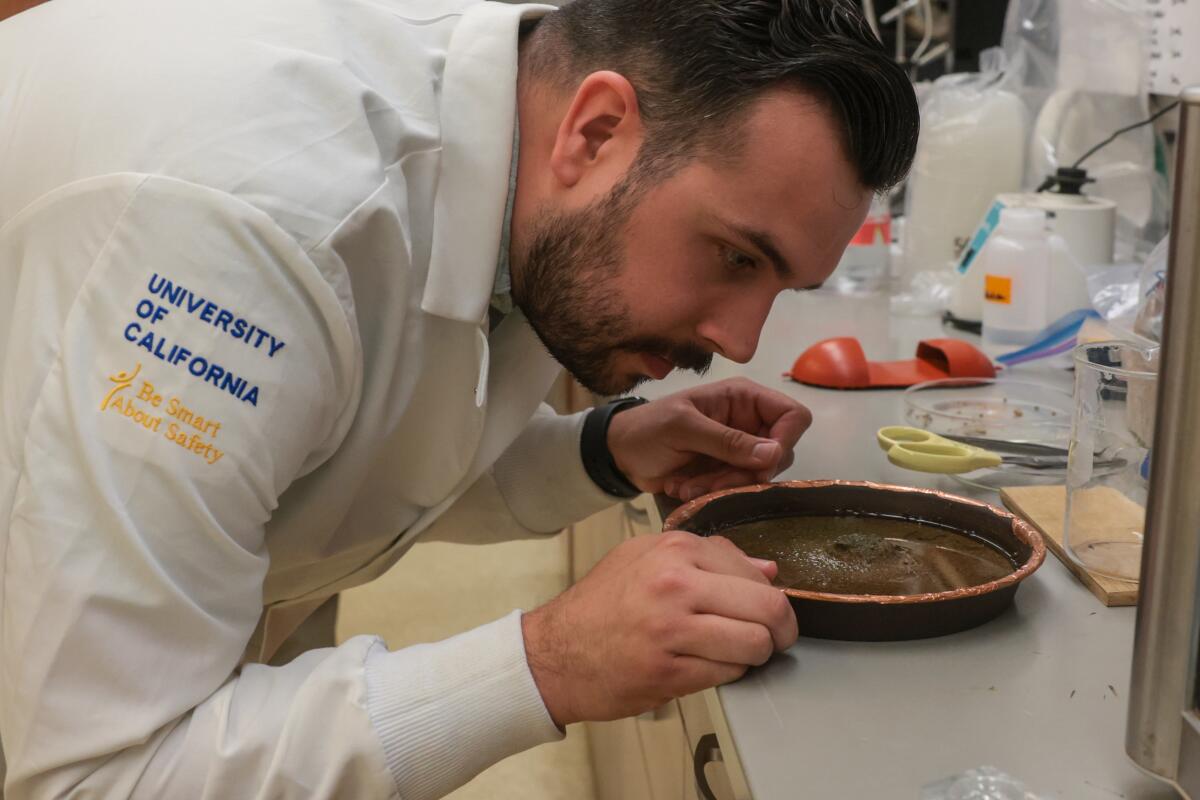
Doctoral candidate Connor Goldy tends to refrigerated habitats for tiny snails at UC Riverside.
(Robert Gauthier/Los Angeles Times)
Tracking down an elusive hunter
Dillman was last featured in The Times in 2024. Then, he and his team of graduate student researchers, dubbed Dillman Lab, linked a mysterious infection of several Southern California dogs to canine schistosomiasis from the flatworm parasite, not previously seen in California.
The breakthrough helped provide awareness of the disease in the region.
Eleven dogs from across three counties tested positive between 2018 and 2023. The actual number of infections is unknown since many cases go undiagnosed, Dillman said.
Since then, just a little over 800 high-risk dogs from Southern California, Nevada and Arizona have been tested by Dr. Kathleen Aicher at Texas A&M. Of those, 24.6% (roughly 1 in 4) have tested positive on at least one of the fecal tests for the flatworm.

Doctoral candidate Connor Goldy focuses a microscope on a tiny snail at UC Riverside.
(Robert Gauthier/Los Angeles Times)
What the disease does
Canine schistosomiasis — flatworm — affects the liver and intestines of dogs and symptoms range from a loss of appetite to vomiting, diarrhea, profound weight loss, signs of liver disease and death.
The L.A. County Department of Public Health issued a warning in 2019, a year after two South Bay dogs were infected. Those cases were linked to a parasite called Heterobilharzia americana, a flatworm commonly referred to as the liver fluke.
Common in Texas and the South, the liver fluke was not known to be in California, Dillman said.
Liver fluke finds new digs
It was suspected those two dogs acquired the disease after swimming in the Colorado River near Blythe, matching similar symptoms and stories from dog owners in Orange, Riverside and San Bernardino counties.
Dillman’s team made four trips to the river between March and August of 2023 to collect more than 2,000 snails of two distinct species known to transmit the worms.
Their work helped confirm that the worm was present in the river and was infecting dogs, entering through their skin and eventually landing in the intestines.
How funding helps
Dillman’s grant proposal “caught the attention” of Stephanie Montgomery, chief executive of the American Kennel Club Canine Health Foundation.
Montgomery noted that the organization’s grants are “quite competitive,” with only 15% to 20% of applicants receiving funding.
“This is a disease that just isn’t on the radars of vets and owners outside the gulf coast and Atlantic states,” she said. “This research is key to bringing this to light and he needed to find funding.”
Dillman said much of his limited funding is tied to multiple annual research trips to the Colorado River, between May and September, the time when the pen-tip-sized snails are most abundant.
“This research is expensive and it requires a lot of travel,” he said. “I send members of my lab to all different parts of the Colorado River, to lakes and streams in and around Southern California, including Lake Mead and Lake Mojave, along with other fresh water lakes.
His goals include identifying water sources where the liver fluke resides, so that pet owners can be aware of “a potential lethal infection in their dog.”
The week’s biggest stories

(Carlin Stiehl/For The Times)
Los Angeles mayoral race
San Diego in the news
Dangerous roads and highways
More news
Editor’s pick
More picks

(Megan Morello/For The Times)
Things to do
Today’s recipe

(Stephanie Breijo / Los Angeles Times)
This spaghetti al limone is for lovers, wrote colleague Stephanie Breijo. Start the sauce by browning butter with crushed garlic — just until it smells like sweet hazelnuts — then add lots of lemon juice and zest and a showering of Parmigiano-Reggiano. Adam Leonti, the chef of Alba in Hollywood, calls this dish made for two “date-night spaghetti.”
Have a great day, from the Essential California team
Jack Dolan, investigative reporter
Hugo Martín, assistant editor, fast break desk
Kevinisha Walker, multiplatform editor
Andrew J. Campa, weekend writer
Karim Doumar, head of newsletters
Shi Bradley, audience intern
How can we make this newsletter more useful? Send comments to [email protected]. Check our top stories, topics and the latest articles on latimes.com.