Evacuation recommendations have been issued for some as many in the Midwest wait to find out if they’ll be in the path of a toxic lead plume sparked by the detonation of bomb-making chemicals in Iowa just one day before the Thanksgiving holiday.
On Wednesday morning, the U.S. Army plans to detonate the nation’s entire stockpile of lead azide in Middletown, Iowa, warning that the dangerously degrading chemicals could otherwise explode at any time.
“Inaction is no longer an option,” said Maj. Gen. Eric Shirley, the Army’s leader of the operation.
Officials on Tuesday began evacuating residents within a specified evacuation zone while others were told to stay indoors and be ready to evacuate if needed.
“We don’t believe that the public should be in a panic,” said Acting Secretary of the Army Adam Telle. “Our goal is to keep as much of it as we can here on our Iowa Army Ammunition plant to prevent it from traveling.”
The evacuations were already underway Tuesday, with the detonation scheduled for 9 a.m. CT Wednesday.
Here’s the latest on what’s happening:
Evacuation recommendations
The Army said the Federal Emergency Management Agency will assist in relocating “all residents of Middletown, Iowa, and immediate surrounding impacted areas” beginning Tuesday.
The evacuation zone was reported to be in “a five-mile cone southwest” of the Iowa Army Ammunition Plant.
“Out of an abundance of caution, the evacuation extends one mile beyond the dispersion path,” the Army said.
An emergency notification sent to cellphones Tuesday morning said those within that zone “may be evacuated,” but the Centers for Disease Control and Prevention urged residents to either “stay indoors or evacuate if you are in the evacuation zone.”
Those within the evacuation zone will be offered transportation to “safe refuge” for those who cannot travel on their own, as well as shelter, including “short-term hotel lodging” and food, water and other supplies through at least Friday, according to the Army.
“Individuals are encouraged to contact FEMA if greater flexibility is needed,” the Army said in its Tuesday update.
Those who do evacuate will be notified by phone when an all-clear is given for them to return home.
Those with questions or concerns about the evacuation zone are being urged to contact FEMA at (800) 621- 3362.
Shelter-in-place orders
Some residents near Middletown have been sealing their windows and doors as a precaution to keep out any lead dust that might result from the detonation. Others who live farther away were raising concern about the possible paths the plume could take depending on the wind.
The Army recommended those outside the evacuation zone, but in the potential path of the plume to shelter in place.
“Best practices include closing all windows and doors, setting heating to recirculate (heat can stay on), turning off fans that pull in outside air (e.g., bathroom vents and kitchen exhausts), keeping small children and pets inside, and covering feed and water for livestock and crops,” the Army recommended. “Infants and children under 6 years old, pregnant women, and individuals with chronic diseases, such as heart disease, dementia, and chronic kidney disease, may be more sensitive to lead exposure and air pollution.”
Officials have recommended that people clean off outdoor surfaces with water afterward to limit exposure to any lead particles.
Missouri Gov. Mike Kehoe said state agencies are working to establish additional monitoring of air and water quality, public health and agriculture resources.
Officials overseeing the plan say the wind on Wednesday is expected to blow southwest and away from nearby Burlington, a city of just under 25,000 people that sits along the Mississippi River.
The “imminent threat alert” told those up to 20 miles away to remain indoors with windows closed “to avoid airborne lead dust, noise and vibration.”
The Army has set up additional “blast barriers” around the bunkers where the lead azide will be detonated, and to apply ballistic gels and foams to absorb the lead dust.
It also plans to douse the materials with thousands of gallons of water.
“We’ve taken every viable solution and considered it,” Telle said. “In every instance, the answer is controlled detonation is safest.”
Those within the path of the plume are being told to:
- Remain indoors during the potential exposure period if you cannot evacuate beforehand. Keep windows and doors closed.
- If it is safe to do so, set heating and cooling systems to “recirculate” to minimize outdoor air exposure and maximize indoor air filtration until the plume passes by your community.
- Avoid unnecessary travel through affected areas and evacuation zones.
- After officials determine the air exposure period has ended, clean indoor and outdoor surfaces that may be contacted by children.
- In the deposition area, wet-clean surfaces that may be contacted by infants or children, including outdoor play equipment, toys, tables and chairs, handrails, patios, decks, exterior windowsills, and other high-contact surfaces.
Map of where the plume is expected to travel
The Army released new maps Tuesday showing the likely trajectory of the plume traveling toward Missouri. Plans for an earlier detonation had the plume headed north and, at times, traveling into Illinois.
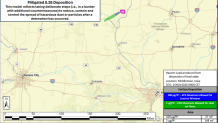
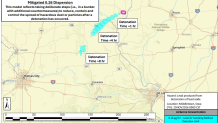
Still, Illinois Gov. JB Pritzker has put state agencies on alert.
According to a press release, Pritzker said the state is preparing for the detonation and a variety of state agencies have been instructed to prepare for that eventuality.
“I have put state agencies on alert to prepare for any potential impacts of the U.S. Army’s planned detonation in Iowa,” Pritzker said.
According to a press release, the Illinois Environmental Protection Agency, Illinois Department of Public Health, and the Illinois Emergency Management Office of Homeland Security have launched a website to alert the public to updates related to the detonation at the Iowa Army Ammunition Plant.
The U.S. Department of Agriculture and the Iowa Department of Agriculture estimated there are approximately 350 farms “that could be impacted based on the anticipated direction of the plume for a Wednesday detonation.”
When is the detonation?
An emergency notification sent to cellphones Tuesday morning said the detonation was planned for 9 a.m. CT Wednesday.
The Army, however, said “a more precise time will be communicated after evaluating changing weather patterns and waiting for the safest possible conditions.”
Why is this happening?
In March, staff at the Iowa Army Ammunition Plant found several dozen barrels of degraded lead azide, which is used in munitions production, had crystalized. The crystallization of the material created an unstable and dangerous situation, prompting the Army to assemble experts in munitions chemistry, engineering and environmental safety to come up with a plan.
“Inspections in April found floating crystals in the drums, mold, and corroded bolts,” according to a report from the Environmental Protection Agency. “The bomb squad (Explosive Ordnance Disposal) team found visible crystal growth in 87% of the barrels and recommended not moving them. Crystallized lead azide is much more sensitive to shock and friction.”
In court filings, Army Col. Aaron Teller, a munitions emergency response specialist, said that less liquid inside the barrels means the solution is more susceptible to freezing, which increases the risk of an explosive chain reaction.
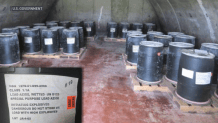
EPA
EPA
According to EPA documents, alternatives to a detonation were considered. But officials said handling the drums would increase the probability of an accidental, fatal blast.
News of the detonation set off concerns about potential health and environmental effects and frustration over a lack of information. Experts have advised that the stockpile will become more volatile as temperatures cool in the coming days.
Environmentalists sued last week to stop the detonation at the site, which is about 90 miles south of Cedar Rapids.
Lead azide is “very sensitive” and also susceptible to heat, freezing, shock, friction and “all sorts of things that could cause an accidental detonation,” said John Goodpaster, a chemistry professor at Indiana University, Indianapolis. It’s also old, which increases the risk because explosives become increasingly unstable as they age, he said.
Add in the environmental threat caused by the lead that will escape into the atmosphere and the challenge is significant, Goodpaster said.
“I do not envy the Army,” Goodpaster said. “They are in a situation where they’ve got a large amount of very dangerous material and not very many good options in terms of trying to dispose of it.”
But it’s impossible to predict when it could explode on its own, he said.
“The longer we wait, the longer the risk accumulates that they might have an accidental explosion,” Goodpaster said.
What is lead azide?
According to the EPA, lead azide is “a primary explosive used in detonators.”
“It was produced in the Vietnam era, stored at Lone Star Army Ammunition Plant in Texas, and moved to Iowa in 2009 in its original cotton bags,” the agency stated in its report.
The substance had been kept in mixture of ethanol and water in two “concrete, earth-covered bunkers built in 1940.”
It’s classified as “hazardous waste” because it’s “both reactive and toxic.”
Potential impacts
Patrick O’Shaughnessy, a professor at the University of Iowa’s Department of Occupational and Environmental Health, said it’s still unknown how much contamination will end up in the atmosphere and on surfaces.
With high doses over a short period, people can be exposed to enough lead to cause poisoning and begin feeling sick, said Andrew Whelton, an environmental engineering professor at Purdue University who has helped communities recover from chemical disasters.
Long-term exposure to low doses can lead to neurological development problems, especially in young children, O’Shaughnessy added.
Will Sander, associate professor of preventive medicine and public health at the University of Illinois, said the detonation is “a potential public health concern.”
“I think it’s a mild concern, but it’s certainly a public health concern, especially for those in the affected area from the plume for this detonation in Iowa,” he told NBC Chicago. “I’m particularly concerned in the first 24 to 48 hours when we have this plume up in the air and then lead particulate dust landing on various buildings, cars, things like that, as well. That’s the time where we might expect to either inhale the lead dust as it’s in the air or potentially come into contact with it by touching surfaces and putting our fingers in our mouths and having issues like that.”
Sander also cited the particular concern surrounding young children.
“The bigger concern for me is for young kids because they’re especially sensitive to lead because of their developmental stage and how they often also get into things a lot easier and put our fingers in our mouths and things like that after touching surfaces,” he said.
“At a minimum, monitoring the wind drift and measuring the impact will give us the most likely area of mitigation.”
It’s still not clear how much lead will be released into the atmosphere following the blast.
Telle said the goal is zero, but that won’t be guaranteed.
“We’ve used state-of-the-art gel blocks in huge quantities all around to ensure that we absorb as much of this blast as we possibly can. Our goal is to keep as much of it as we can here on our Iowa Army ammunition plant to prevent it from traveling outside,” he said.
In addition, Shirley said there will be “a series of earthenworks” as well as “mister systems” to dampen the ground around the area “to provide a first layer protection to capture any particulate matter.” There will also be a “PFAS-free and environmentally friendly mitigating foam” to capture additional particles,” he said.
Beyond the health impacts, environmental concerns are also heightened by the blast, experts warned.
“The wildlife, the water quality,” Wally Taylor, legal chair of the Iowa Chapter of the Sierra Club said. “When this stuff is dispersed out in the air, it eventually falls on the ground, and we are right next to the Mississippi River. That could be contaminated.”
Vishal Verma, a professor of civil and environmental engineering at the University of Illinois Urbana-Champaign, said “surface water contamination is a legitimate concern.”
“But it is generally expected to be a more localized issue, particularly near the source and in smaller water bodies,” he said. “Lead can reach surface water through direct deposition in waterways and through runoff after deposition. Particles can settle directly onto rivers, lakes, ponds and reservoirs. Large rivers such as the Mississippi River would provide substantial dilution. Smaller and relatively stagnant water bodies, however, may be more vulnerable. Examples include farm ponds, livestock watering tanks, rain barrels and cisterns that collect runoff from roofs.”
There’s also the possibility than rain or snow can carry particles into ditches, streams or other areas of water.
“Most lead compounds have relatively low solubility and tend to bind strongly to soil. As a result, they often remain close to where they were deposited rather than traveling long distances downstream,” Verma said.
“The detonation of this material risks the health of the food supply and the farmers and workers that produce this food. We are asking for accountability from those in charge to ensure human and environmental safety is a key decision factor in this process,” MFU President Katie Nixon said in a statement.
“It is concerning the level of uncertainty that is placed on farmers and rural communities around the area that may be affected by this detonation and the resulting effects on farmland, animals and those working the land. More should be and can be done by agencies to inform and protect all that may be downwind,” ILFU Advisory Committee Chair John Williams said in a statement.
Symptoms to watch for
Sander said “at the levels predicted, it is unlikely that any clinical signs would be noticeable in people or pets,” but noted that signs of exposure could include “fatigue, learning challenges, disorientation and some general weakness.”
“This would be similar in pets as well with lethargy, disorientation and decreased appetite,” he said.
The Associated Press contributed to this report.