The comedian was on the witness stand, trying to explain himself.
Night after night, under constant threat of arrest from L.A. vice cops, Lenny Bruce had been waging a dangerous campaign to liberate stand-up comedy from Borscht Belt one-liners.
He delivered freewheeling political satire, jabs at the powerful, and jazz-like verbal riffs, employing unfettered language that future comics would take as their birthright.
But it was February 1963, and Bruce was facing obscenity charges in Beverly Hills Municipal Court. The prosecutor demanded to know what he hoped his audiences would get from his act.
Nothing less than compassion for the human race, Bruce explained. Cops were filling jails with people who didn’t belong there.
“I want them to stop punishing each other, and I want them to open up the jails,” the 37-year-old Bruce testified. “I’m seeking some pity for the people that are doing dead time in County.”
His trial, he explained, was a total waste of time and taxpayer money. “Insanity,” he said. “Preposterous.”
The obscenity charges stemmed from performances at The Troubadour nightclub on Santa Monica Boulevard and The Unicorn coffeehouse on the Sunset Strip. He had said “asshole.” He had called someone a “dwarf prick.” He had called someone else a “schmuck bastard.” He had done a bit in which the Lone Ranger fantasized about an “unnatural act” with Tonto and a horse.
It was not Bruce’s first trial on such charges, nor his last. There were narcotics busts too, which he blamed on the vice squad’s zeal to punish him for his nightclub act. To deter questions about the needle marks in his arms, he had taken to carrying a doctor’s note that authorized intravenous methamphetamine for “episodes of severe depression and lethargy.”

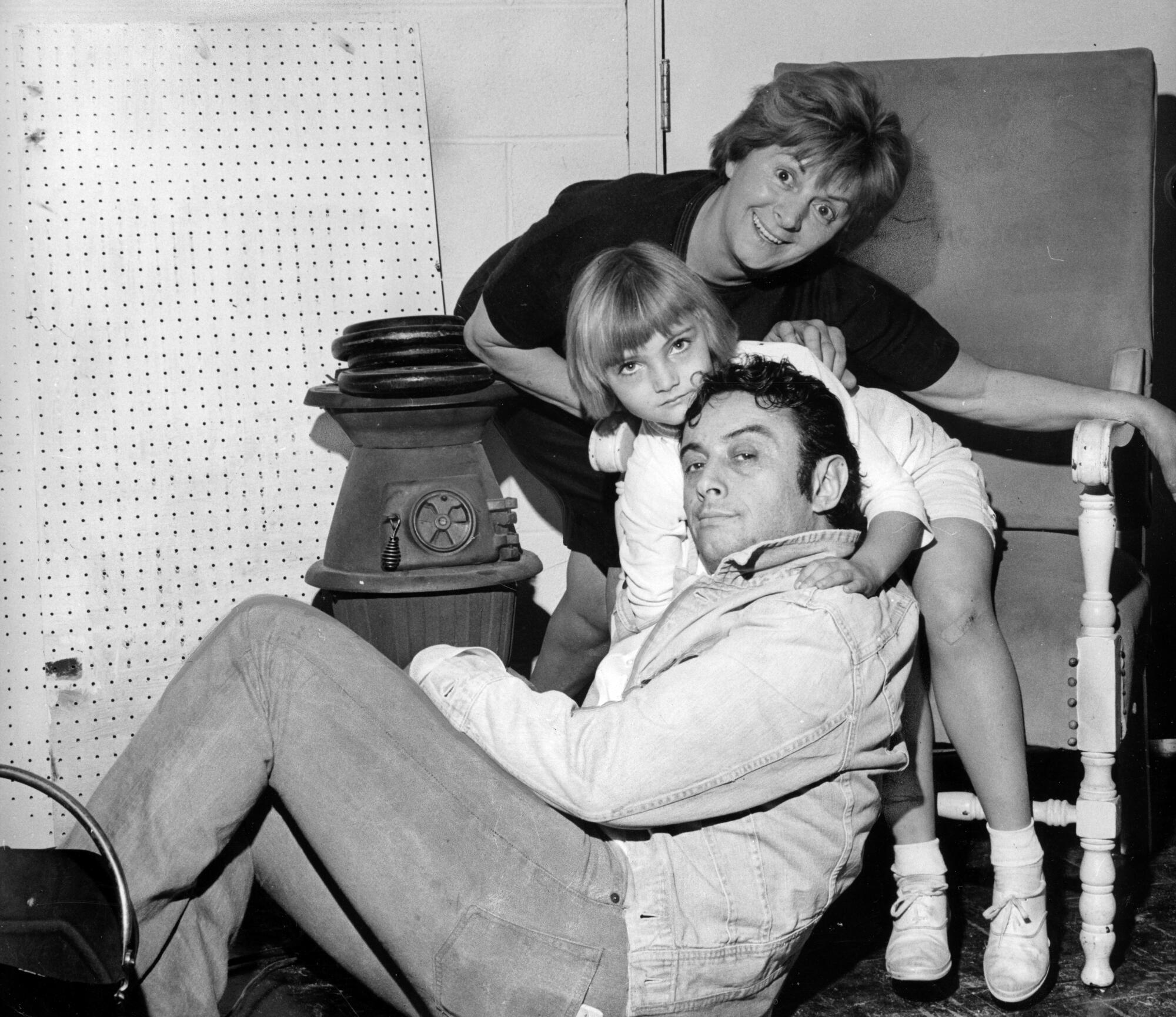
Lenny Bruce with his mother, Sally Marr, and his daughter, Kitty.
(Don Cormier / Los Angeles Times)
Within years, the iconoclastic comic was a weary and defeated man — broke, baggy-eyed, and prematurely old. His trailblazing act had been reduced to a joyless recitation of his legal entanglements. He read trial transcripts onstage while audiences walked out.
In August 1966, when Bruce died of a heroin overdose at the age of 40, Los Angeles authorities who had hounded him for years decided it was a good time for a photo op. For hours, they escorted journalists and photographers into his Hollywood Boulevard home to view his corpse.
“Lenny Bruce, for whom the tag ‘sick comic’ was invented, died a sick death, alone and naked on the bathroom floor of his Hollywood home Wednesday night,” wrote Times critic Charles Champlin. “He was needle-scarred, with a junkie’s paraphernalia close at hand.”

In this series, Christopher Goffard revisits old crimes in Los Angeles and beyond, from the famous to the forgotten, the consequential to the obscure, diving into archives and the memories of those who were there.
The Bruce death photos were widely seen. It was as if police did not want anyone to miss the squalor of his last days, and by extension, the degeneracy of his act.
“I don’t think it’s necessary to get into their mens rea, or mindset,” Ronald K.L. Collins, a 1st Amendment scholar, told The Times in a recent interview. “The net effect was to leave this image of Bruce as this dirty, vulgar drug user. From their point of view, he was a bad guy,” a notion “that would have been shared with a lot of people.”
But many of his friends and supporters were quick to link his disintegration to law-enforcement harassment. Phil Spector, who produced his records, took out an ad in Billboard that declared: “He died from an overdose of police.”
There was a play, a 1974 feature film starring Dustin Hoffman, documentaries, books, and an affectionate but sanitized portrayal of Bruce on the Amazon series “The Marvelous Mrs. Maisel” that introduced him to a new generation.
Bruce has come to occupy a place of singular reverence among comedians and 1st Amendment advocates. “He leaves this earth, and he resurrects as this saint of comedy, albeit a dangerous saint. He resurfaces as a cultural hero,” said Collins, co-author (with David M. Skover) of “The Trials of Lenny Bruce: The Fall and Rise of an American Icon.”
Martyrdom became central to his myth.
“He died for freedom of speech,” said comedian Eddie Izzard.
“Lenny died for our sins,” said Playboy publisher Hugh Hefner.
***

Lenny Bruce, center, being treated after a 1957 brawl at a Sunset Strip cafe. Bruce was breaking away from mainstream constraints in favor of uncompromising, countercultural stand-up comedy.
(Don Cormier / Los Angeles Times)
Bruce, born Leonard Alfred Schneider on Long Island, quit school at 16 and got his start telling jokes at a Brooklyn nightclub for $12 a week. He joined the Navy and took acting classes in Hollywood on the GI Bill. He developed his act in smoky strip clubs and jazz joints around Southern California in the mid-1950s. He riffed in a Beatnik argot, and his act took on the flavor of improvisational jazz.
He made organized religion, bigotry and hypocrisy his regular targets. “Every day people are straying away from the church and going back to God,” he would say. His act “Religions, Inc.” lampooned the Madison Avenue-like peddling of faith as a salable commodity. He imagined what Jesus would make of the opulence of the Catholic Church’s headquarters.
There were words that offended him, he said. Among them were “segregation,” in an era when it was legal, and “Governor Faubus,” referring to the Arkansas governor who fought to prevent the integration of a Little Rock high school.
More than one observer noted that he approached stand-up comedy like an evangelist with a pulpit. “He preaches that sex is not dirty, that drug addicts are not criminals, and that homosexuals should not be prosecuted,” wrote critic Kevin Thomas.
***
The Beverly Hills trial lasted two days. One of the prosecution’s star witnesses was a young vice squad sergeant named Sherman Block, later to become the four-term sheriff of Los Angeles County. He had arrested Bruce at The Troubadour in October 1962. Like the iconoclastic comedian, Block was Jewish, with a knowledge of Yiddish, which had been deemed advantageous for the assignment.
“When you went to this place on the 24th, was it not your express position to be sort of a Yiddish undercover agent?” defense attorney Burton Marks asked Block. “That is, to understand the Yiddish words that Mr. Bruce used?”
“Along with the English, yes, sir,” Block said.
“There were some words like ‘schmuck’ used?”
“There were.”
“Have you ever used that word?
“I have.”
“In public?”
“Perhaps.”
In his routine, Bruce had also invoked a Yiddish term for buttocks, and his attorney asked Block if he’d employed it publicly himself.
“Tuchas?”
“Perhaps.”
“What was the theme of Mr. Bruce’s commentary?”
“I couldn’t see any overall theme.”
Like the other vice cops, the future sheriff admitted that he’d found some of Bruce’s act funny. But the prosecutor maintained that it had aroused the “prurient interest” of the audience, which prompted the defense attorney to ask: “Anybody at that show, after hearing Mr. Bruce, did they masturbate?”
Block was not allowed to answer. The judge called it an “entirely improper” question.
“Did you think that Mr. Bruce’s show was perverted?”
Block said he regarded homosexuality as a perversion, and so Bruce’s references to homosexual acts were perverted.
When Bruce took the stand, he compared himself to the satirist Jonathan Swift.
“I usually report the contemporary scene,” he said. “I don’t profess to be solely a comedian.”
“Do you think that the material which you use appeals to anyone’s prurient interest?” his attorney asked.
“Only the most perverse. Or illiterate.”
Some of his act was meant to be “just completely ludicrous,” he explained. Not all of it had “heavy-weight meaning.”
“Nobody is like Lenny Bruce,” his attorney told jurors. “He tries to impress upon people the incongruity of our social situation.” The act was not meant to arouse the audience sexually. “You just cannot be having lascivious thoughts while your risibilities and your laughter is aroused.”
The jury deadlocked 7 to 5 in favor of acquittal, and prosecutors dropped the case. But local vice cops were not done with him. He found it easy to spot them in the clubs, and sometimes worked their presence into his act.

Lenny Bruce at Los Angeles County General Hospital in June 1963, days before a court ordered him confined to a drug rehab center.
(Bill Murphy/Los Angeles Times)
They arrested him again, this time for his act at the Trolley Ho nightclub, at the corner of La Cienega and San Vicente. His prosecutor was a young Johnnie Cochran, later to be a superstar defense lawyer, then a deputy city attorney.
“My first celebrity trial,” Cochran called it. In his memoir “Journey to Justice,” Cochran described the comedian as “a rumpled, sad-eyed man with an alcoholic’s pallor under a five o’clock shadow,” a man who appeared “defiant and doomed.”
By Cochran’s account, the 1964 prosecution relied on Sherman Block’s surreptitious recording of Bruce’s act, much of it rendered inaudible by the crackling of the deputy’s well-starched shirt.
Among the complaints, this time, was Bruce’s take on Jackie Kennedy’s behavior in the moments after her husband’s assassination. Time magazine had portrayed her impulse to climb out the back of the presidential limo as heroic. Bruce maintained that she, understandably, had merely been “hauling ass to save ass.”
The judge, by Cochran’s depiction, found it deeply offensive — but nevertheless tossed the case on 1st Amendment grounds.
New York authorities later prosecuted him successfully on obscenity charges, however, for his performance at the Cafe Au Go Go in Greenwich Village. It led to his blacklisting, and deepened his obsession with his legal woes.
“If you talk to any comedian they’ll tell you it was Lenny who kicked down the doors, at terrible personal cost,” said Robert Corn-Revere, an attorney who led the successful effort to win Bruce a posthumous pardon from the New York governor.
During Bruce’s life, obscenity law was evolving to afford greater protections to artists and writers. “Even under the evolving law at the time, he should never have been convicted,” Corn-Revere said. “Now it would be unthinkable that a prosecution like that could be brought.”
Though he was a hero of liberals for decades, Bruce’s language now makes them cringe. His act made use of racial and ethnic slurs, under the philosophy that taboo words lost their maiming edge with repetition. This is far from the left’s current view.
“There has been a cultural shift. It’s fair to say that Lenny even after death became a victim of cancel culture, as people became more sensitive about language,” Corn-Revere said.
He pointed to the 2017 cancellation of Michael Weller’s play “Buyer Beware,” which was scheduled to be performed at Brandeis University in Massachusetts. It’s about a student who discovers Bruce and decides to mount a show inspired by his work, only to encounter the wrath of humorless student activists.
When Weller’s script got around, wrathful student activists declared the play would be “harmful to the student population if staged.” It was canceled.
“I’ve watched my audience change right before my eyes,” said Ronnie Marmo, a Los Angeles actor who plays Bruce in a one-man show called “I’m Not A Comedian … I’m Lenny Bruce.”
“Before the pandemic, people on the left, they’d come out and they’d love Lenny. He fought for the brown and black people, the voiceless people. Then when George Floyd [was killed] suddenly the people on the right were screaming ‘Don’t take away my words.’”
Collins, the 1st Amendment scholar, said that after Bruce’s death, no American court convicted a comedian for obscenity again. But much of his act would be unwelcome on college campuses today.
“He may have been the darling of liberals in the ‘60s, but today with the whole PC mindset there’s no way that some of his comedy would be tolerated,” he said. “I feel no need to sugarcoat Lenny Bruce. He offended me at times.”