Skin cancer is sneaky, but it can be caught early with the watchful eye of a dermatologist.
Dr. Michelle Henry, founder of Skin & Aesthetic Surgery of Manhattan, sometimes spots it on patients who book a visit for other reasons. The last melanoma she found was on a woman who came in for laser skin resurfacing. When she took off her cardigan, Henry saw it on her forearm.
The doctor and clinical instructor of dermatology at Weill Cornell Medical College turns that watchful eye on herself as well.
“I’m constantly surveying my skin,” Henry, who serves on the board of the Melanoma Research Foundation, tells TODAY.com.
“I have the same sort of vigilance that I have with my patients for myself. I use sunscreen, I reapply, I wear a hat, I wear sunglasses.”
Many people regularly check their skin for suspicious spots, but they often miss “double-covered areas” hidden beneath underwear or socks, she says, including buttocks or soles of feet. The scalp and the skin behind the ears are other commonly missed places where skin cancer can lurk.
To monitor herself for skin cancer, Henry performs at-home checks on her body every month, and has a colleague look at areas she can’t see as well. Her hairstylist checks her scalp at every visit and takes pictures of any new spots. Photos are important because “memory is not perfect” so the images can be used for comparison over time, she notes.
The dermatologist also checks her nails whenever she gets a manicure to check for signs of acral lentiginous melanoma, which can grow on the extremities.
“I always remind everyone that’s what Bob Marley died of, so I’m always paying attention to my hands and feet, and those areas that I know (melanoma) can be really devastating in darker skin types,” Henry says.
Knowing what she knows, here are skin cancer symptoms Henry pays attention to in her own body:
Suspicious mole
Henry looks for the ABCDEs of melanoma, the deadliest type of skin cancer:
Asymmetry
This means a mole’s one half doesn’t match the other — they should be roughly mirror images of each other, she notes.
Border
She checks if a mole’s border is irregular, scalloped or poorly defined. She also notices if a mole has an “offshoot — like one part of the mole looks like it’s growing faster or changing more rapidly.”
Color
A mole that’s ink black or has multiple colors is suspicious.
Diameter
“It should be smaller than a pencil eraser, although many melanomas are smaller,” Henry says. “But the larger it is, the more concerning.”
Evolving
Besides moles that change shape or color, Henry is also on the lookout for new ones. “I’m in my mid-40s. After the age of 40, really any new mole becomes concerning. We don’t expect as many new moles,” she says.
Which of these signs would be most worrisome? The dermatologist says it’s hard to pick one since the more features a mole has, the more concerning it is.
“(But) at the end of the day, melanoma is a cancer of the pigment itself. So if you see something that looks completely ink black, that is going to be a big sign for you that that might be a melanoma,” Henry says.
‘Ugly duckling’ mole
This is a mole that stands out because it just looks or feels different from other spots on the body. The ugly duckling mole could also be the sole lesion in a part of the body that doesn’t have any other spots.
“Our bodies are kind of boring creatures. … (They’re) literally machines of habit, and we kind of pump out the same things again and again,” Henry says.
“So if you see a mole that looks interesting, that’s not a good thing.”
Mole with symptoms
Any spot that itches, bleeds, feels painful, turns white or just doesn’t heal piques Henry’s suspicion.
It’s also important to notice unexplained weight loss or lumps where lymph nodes are located.
“In my skin exams, I check everyone’s lymph nodes, because you can get swollen lymph nodes if you have a melanoma or skin cancer in that area,” she says.
Streaks on nails
A vertical dark line on a nail can be a sign of acral lentiginous melanoma.
Any new streak on the nail should be checked out, especially one that’s wider than 3 millimeters, is ink black or disrupting the texture and surface of the skin, Henry says.
Pearly bump or scaly patch
A pearly bump can be a sign of basal cell carcinoma, the most common type of skin cancer. A scaly patch may indicate squamous cell carcinoma.
How to get help
Regularly check your skin, and if you see something, say something, Henry advises patients.
“It will never be a bother to me, but it could save your life,” she says.
“We also don’t want people to live in a constant state of anxiety, worried about every mole on their body. That’s why I always tell my patients, ‘Let me worry. All you have to do is come in once a year. Let me check your moles.’”
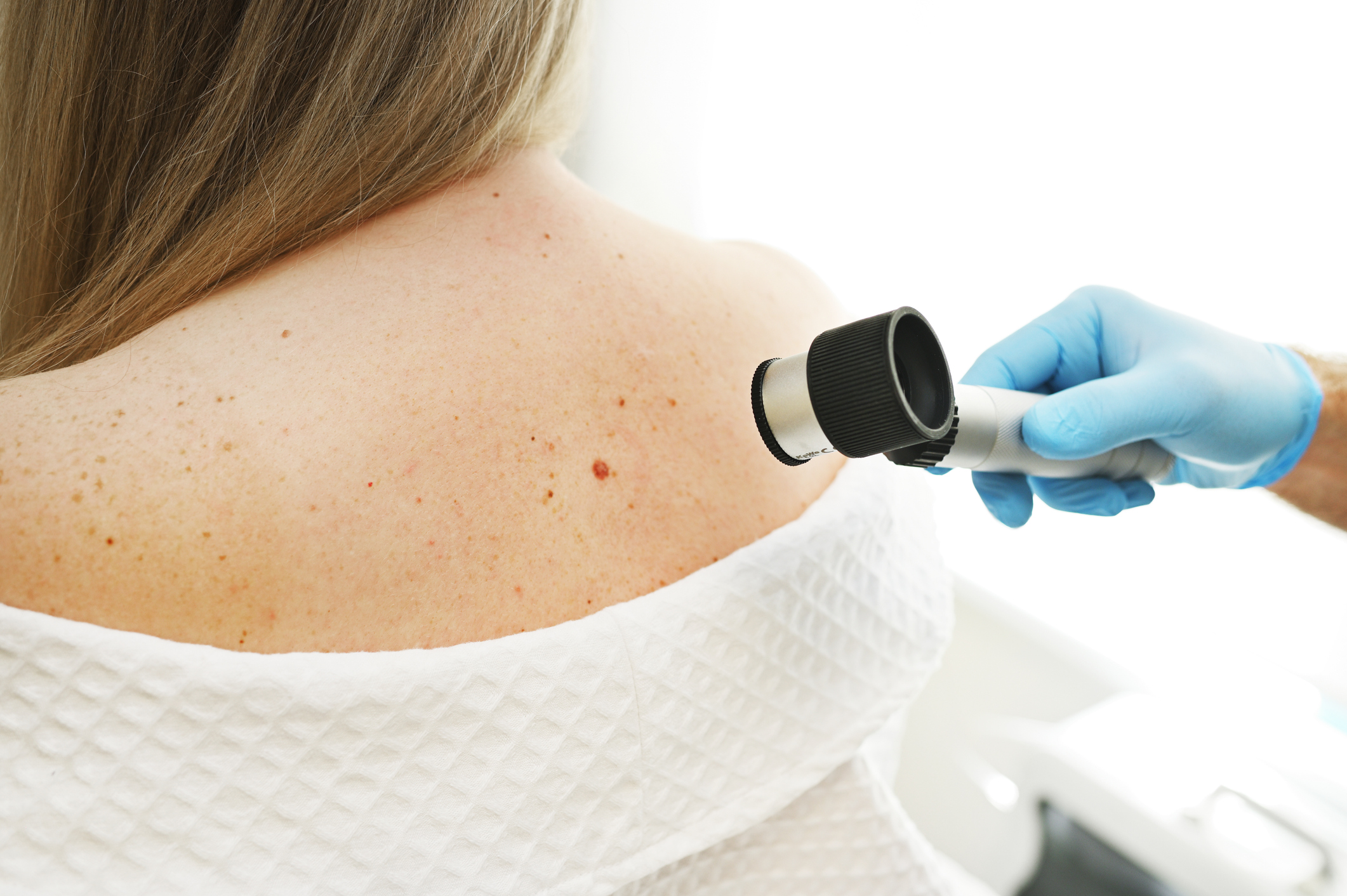
Most dermatologists now use a dermatoscope, a handheld magnifying device that lets them see deeper into the skin and observe its structures and pigment in a way they could never see with the naked eye, Henry adds. It reduces biopsies of benign moles.
But she will quickly biopsy her own skin if she finds a concerning spot.
“If I see something, I do something. I don’t wait, because I’ve seen these things progress really rapidly. So the best thing we can do is early prevention,” Henry says.
Regular eye exams can reveal ocular melanoma inside the eye. Gynecologist checks can discover vaginal melanoma.
Preventing skin cancer
July is UV Awareness Month. Exposure to ultraviolet rays from the sun is a risk factor for all types of skin cancer.
To protect herself, Henry uses a broad-spectrum, water-resistant sunscreen that protects against UVA and UVB rays. She likes both chemical and mineral sunscreens, applying SPF 30 for daily use, and SPF 50 if she’s outside for more than an hour.
The doctor is enthusiastic about bemotrizinol (BEMT), a sunscreen ingredient that’s popular in Europe and has just been approved by the U.S. Food and Drug Administration.
It has broader UVA coverage than current options, is more stable — meaning it doesn’t break down in the sun — and is less irritating, Henry says. It also “blends beautifully into skin,” she adds.
“Dermatologists are over-the-moon excited that we now have this option,” she says. “We’re hoping that this addition will improve compliance and save lives.”
This story first appeared on TODAY.com. More from TODAY: