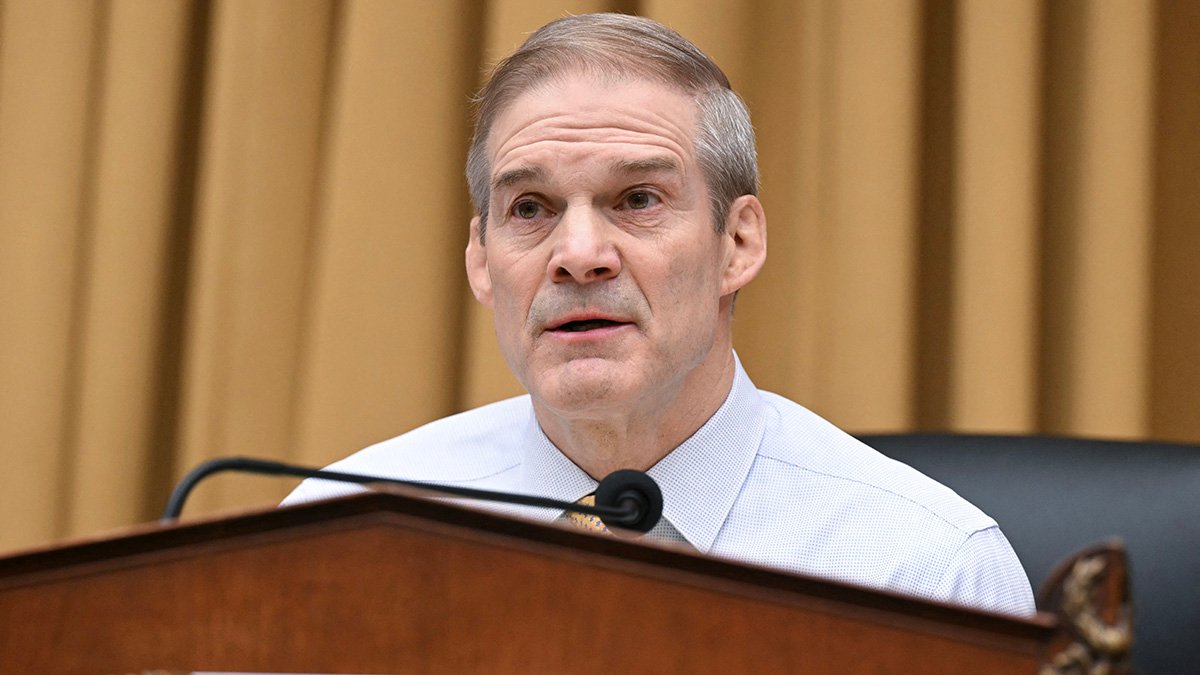
After a blue tidal wave swept them from power, House Republicans on Tuesday elected a new GOP leader to replace outgoing Speaker Mike Johnson, R-La.
House Judiciary Chairman Jim Jordan, R-Ohio, defeated Majority Leader Steve Scalise, R-La., a close Johnson ally, for minority leader, two Republican lawmakers said. The vote was held behind closed doors and by secret ballot.
The vote was 106-73, the two lawmakers in the room said.
“Over the next two years, House Republicans will fight for American families,” Jordan told reporters after his victory. “When Democrats offer more government, we’ll offer more freedom, and we will bring that fight in committee, on the floor, and on the stump every single day.”
Jordan is a fervent supporter of President Donald Trump and had pitched to GOP colleagues that his past role chairing the Oversight Committee would allow him to combat the spate of investigations newly empowered Democrats have promised to launch into Trump’s administration, family and business ventures.
Democrats scored a seismic victory in the midterm elections, winning control of Congress — and flipping seats in deep-red and battleground states. NBC’s Hallie Jackson and “Meet the Press” moderator Kristen Welker join “TODAY” with analysis.
“I am battle-tested on the oversight front and I know the Democrats’ playbook,” he wrote to his colleagues.
Jordan’s victory signals that House Republicans wanted a clean break from the Johnson political apparatus following last week’s historic GOP drubbing that handed Democrats roughly 260 seats — the largest majority in 35 years.
It’s a remarkable ascent for Jordan, who has spent two decades in Congress and had once been considered a conservative bomb-thrower who often clashed with the GOP leadership team, though the ambitious Republican has become more of a team player in recent years as he led House committees.
Senate Republicans also held their leadership elections on Tuesday, re-electing their current leadership slate after a small group of conservatives had pushed to delay the election. Sen. John Thune of South Dakota will serve as minority leader in the next Congress.
The House: Jordan’s ascent and other races
Jordan, 62, started climbing the ranks after the Tea Party wave swept Republicans into power in the 2010 midterms, winning the race to lead the Republican Study Committee, the largest caucus of conservatives on Capitol Hill.
He and a handful of other conservative hardliners then formed the House Freedom Caucus, a smaller, more nimble and more conservative caucus that aimed to pull the GOP Conference further to the right. Among that group were Ron DeSantis, who would go on to become Florida governor, and Mark Meadows and Mick Mulvaney, who would both serve as Trump’s chiefs of staff.
At HFC, Jordan famously tangled with a fellow Ohio Republican, then-Speaker John Boehner, and caused headaches for Boehner’s successor, then-Speaker Paul Ryan, R-Wis.
After Republicans lost the majority in the 2018 anti-Trump wave election, Jordan challenged California Republican Kevin McCarthy for minority leader, but was easily defeated. The vote was 159 to 43.
Also in 2018, former students at Ohio State University, where Jordan was an assistant wrestling coach, brought forward allegations of sexual abuse by the team’s doctor. Jordan has repeatedly denied any knowledge of the abuse by Dr. Richard Strauss, who abused hundreds of men over decades, according to an independent investigation; Strauss died in 2005. In July 2018, a group of former wrestlers accused Jordan of failing to stop the abuse, saying it was common knowledge.
After McCarthy resigned as speaker of the House in October 2023, both Scalise and Jordan ran to succeed him but failed to secure the required 218 votes. Johnson, then the little-known and low-ranking vice chairman of the GOP Conference, catapulted to the speakership.
A day after last week’s Democratic rout, Johnson said he was stepping down from the leadership team. Johnson is close with both Jordan and Scalise, considering them mentors. But Scalise, who argued he could best unify factions of House Republicans against the “socialists” coming to Washington, has served in Republican leadership positions since Boehner was speaker and Jordan represented more of a change.
In other races, Majority Whip Tom Emmer, R-Minn., fended off an insurgent challenge from Rep. August Pfluger of Texas, for the GOP whip job, the party’s top vote counter and the No. 2 post in the minority, Republicans said. Emmer built up political goodwill with colleagues by serving two terms as chairman of the House GOP’s campaign operation. Pfluger is wrapping up his term as chairman of the Republican Study Committee, the largest caucus of conservatives on Capitol Hill.
And House GOP Conference Chair Lisa McClain of Michigan successfully beat back challenges from two colleagues: Erin Houchin of Indiana, who holds a lower-level leadership post, and Greg Steube of Florida, who berated the current leadership team for choosing “accommodation over conviction.”
House Speaker Mike Johnson attributed Republican midterm losses to historical trends, telling supporters that keeping the House majority would have required defying more than a century of midterm history.
The Senate: Thune beats out grumbling
Senate Republicans also held their own closed-door vote Tuesday to pick their leaders. But a small group had sought to delay the vote, saying the party needs more time to process the election results.
Lacking a challenger, Thune was re-elected by his colleagues, alongside John Barrasso of Wyoming and Tom Cotton as the second-ranked and third-ranked Republicans for the next Congress. Barrasso will be the minority whip, while Cotton serves as chair of the Republican conference.
Though the vote was held behind closed doors and in a secret ballot, as in the House, all three were elected by acclamation, meaning there was no dissent and no vote, Thune spokesman Ryan Wrasse said. The entire leadership team was reelected.
“A week ago, we had the worst election result in decades. We need a discussion about what went wrong, how we fix it, what we stand for, and how our agenda must focus on the concerns of the American people,” Sen. David McCormick, R-Pa., said in a statement.
“As I’ve shared with Leader Thune, I don’t believe we should move to leadership elections until we have digested and debated the lessons of the midterms and how to move forward,” he said. “We need leadership in place fast, but Tuesday is too soon.”
Five other Senate Republicans, led by Budget Committee Chairman Ron Johnson of Wisconsin, sent a letter to Senate Republican Conference Chairman Tom Cotton of Arkansas asking for “a robust discussion and evaluation of how those running for leadership intend to lead” before the elections are held Tuesday morning.
Sen. Johnson walked out of the leadership election after Republicans voted to proceed with voting on Tuesday, that vote was 31-15.
Senate Minority Leader Chuck Schumer addressed Democrats after the party gained control of the Senate and House of Representatives.
Jeffries and Schumer favorites to lead Dems
After last week’s Democratic rout, House Minority Leader Hakeem Jeffries and Senate Minority Leader Chuck Schumer, both New York Democrats, are favorites to be the next House speaker and Senate majority leader.
But they, too, face grumbling from rank-and-file members.
No one has emerged to challenge either for the top jobs, though Sen. Chris Van Hollen, D-Md., opened the door Monday to potentially running for majority leader amid a push from the grassroots to find an alternative to Schumer.
A person familiar with Van Hollen’s thinking told NBC News on Monday: “The senator has received an outpouring of calls on running for majority leader and is now in active listening mode. The door is not shut.”
Democrats at the Senate’s new-member orientation Monday said the question of their leadership team hasn’t come up in private conversations.
House Minority Leader Hakeem Jeffries, D-New York, reacted to Democrats regaining control of the House, pledging to tackle the affordability crisis and “revive… the American Dream.”
“Most of us are just trying to figure out where our office is and how to find the bathroom,” said Sen.-elect Peggy Flanagan, D-Minn. “It’s really exciting to be here and to meet a lot of my colleagues who’ve been campaigning. I know how hard we’ve been working. And to be here together — it’s really exciting.”
As for Van Hollen’s potentially running for majority leader, Flanagan said she is “certainly open to new leadership” but is “not ready to make any commitments at this point.”
Senate Democrats will elect their leadership team in a private meeting in early December, while House Democrats will pick their team next week.
Several progressives have said they are undecided about whether to back Jeffries for speaker as grassroots groups urge the party to more aggressively confront Trump and enact progressive policies.
“We’re not withholding votes. What we’re doing [is] saying we’re undecided,” said Rep.-elect Adam Hamawy, D-N.J. “We want to sit and have a conversation about the issues and what’s the plan going forward.”
But Jeffries has such a large majority — NBC News projects Democrats will secure 259 seats — that he can afford roughly 40 defections and still win the 218 votes needed to become speaker on the House floor on Jan. 3.
“We’re going to work as hard as we can to get to the 218 number, and we’re confident that we will get to that number and beyond,” Jeffries told reporters when he was asked about disgruntled progressives.
Jeffries and his top lieutenants, Katherine Clark of Massachusetts, Pete Aguilar of California and Ted Lieu of California, are so far running unopposed for the top four leadership posts: speaker, majority leader, majority whip and Democratic Caucus chair.

