Brown bears on the Alaska Peninsula are getting ready for hibernation, but not before they compete in a popular online contest.
Fat Bear Week has arrived, pinning 16 contenders against one another in a battle of brawn and bulk.
The reigning champion, 32 Chunk, is looking to go back-to-back, but it will have tough competition from other bears — and even some of their cubs.
How will it all bear out? Here’s everything to know for 2026 Fat Bear Week.
How does Fat Bear Week work?
Fat Bear Week is an annual tournament held by Explore celebrating bears’ success in preparing for winter hibernation.
Sixteen large brown bears from Alaska’s Katmai National Park will go to head-to-head in the single-elimination bracket. People vote on the winners for each matchup, and one bear will eventually be crowned the Fat Bear Week champion.
Explore encourages voters to select the bear that “best exemplifies fatness and success in brown bears.”
When does Fat Bear Week start?
Fat Bear Week begins on Tuesday, Sept. 22.
How to vote in Fat Bear Week
You can vote on Explore’s website.
Voting is open Sept. 22-29 between 12-9 p.m. ET/9 a.m.-6 p.m. PT.
Explore
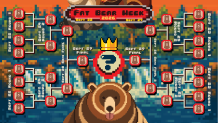
Explore Fat Bear Week runs from Sept. 22-29.
Meet the 2026 Fat Bear Week bears
This year’s contestants are broken up into four categories: bear families, subadults, single adult females and adult males.
Bear families
- 132 and Spring Cubs: This mother is a large adult female with grizzled dark brown fur, forward leaning ears, and a wide belly. Her face is distinguished from other bears by the inverted V or chevron pattern of fur on her forehead.
- 284 and Spring Cubs: This mother has a prominent shoulder hump, grizzled brown fur, and blond-tipped ears.
- 610 and Spring Cubs: This mother is a small adult female with a long muzzle and grizzled light brown fur. A large scar is sometimes visible at the top of her hips.
- 806 and Mixed Age Cubs: This mother has round blond-tipped ears and grizzled brown fur. In early summer, she can have a short mane of longer fur around her head and face.
- 901 and Spring Cub: This mother is a medium-sized adult female who has blond-rimmed and triangle-shaped ears. Her fur is golden brown in early summer and grizzled brown in late summer.
Subadults
- 620: This female subadult bear has a long tail and light brown fur that becomes grizzled brown by late summer.
- 694: This male subadult has round ears placed high on his head and uniformly brown fur with hints of a remnant natal collar (a ring of lighter colored fur) near his neck.
Explore
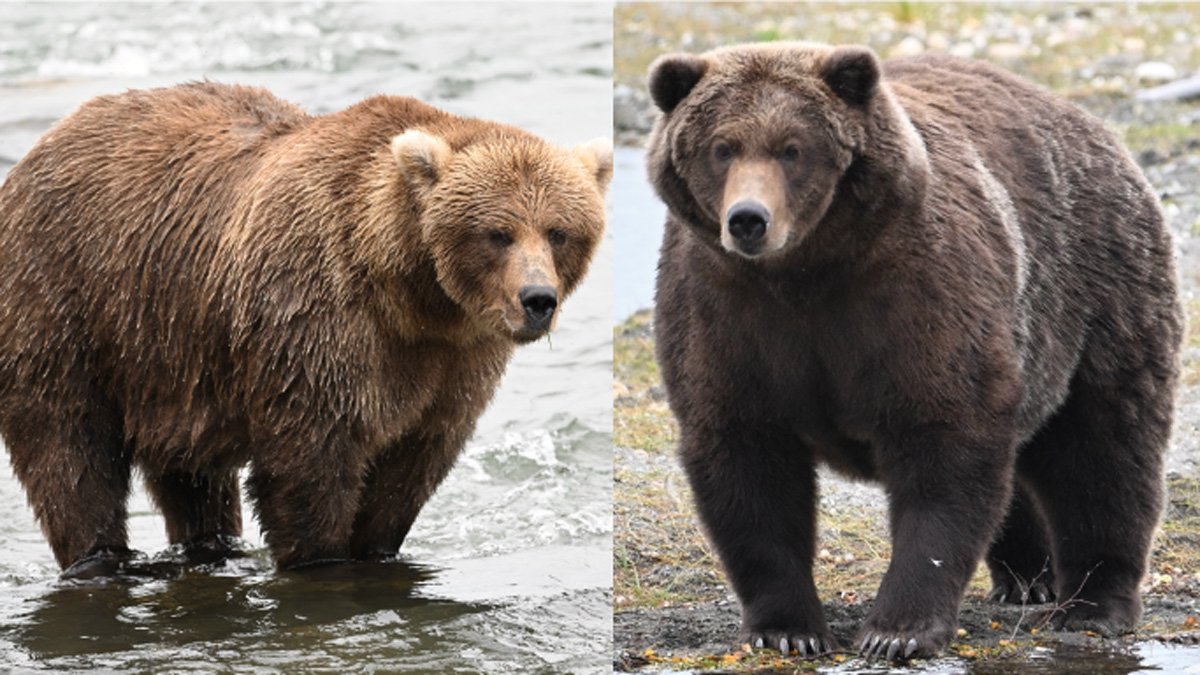
Explore 131 Marshmallow and 910.
Single adult females
- 131 Marshmallow: This bear has blond ears, dark eye rings, a short muzzle, and light brown to blond fur that turns grizzled brown by late summer.
- 428 Studious: This small adult female has a short-pointed muzzle, blond ears, and grizzled blond fur in late summer.
- 909: This is a large adult female who has brown late summer fur and wide set, blond ears.
- 910: This is a large adult female who has dark brown fur, a prominent brow ridge, and somewhat short forward-pointing ears.
Adult males
- 32 Chunk: This is a large adult male who has a large distinctive scar on his muzzle and a protruding canine tooth from a broken jaw suffered in 2025.
- 89 Backpack: This is a medium-large adult male with blond ears, light brown fur in early summer, and grizzled brown fur in late summer. He has relatively few visible wounds and scars compared to most adult males in his size and age class.
- 151 Walker: This is a large adult male with dark brown fur, a pear-shaped body, a long muzzle, and large round ears.
- 164 Bucky: This is a large adult male who has grizzled brown fur and blond-tipped ears tipped. Many observers identify him by a line of darker fur near his eyes on his upper muzzle.
- 903 Gully: This is a medium-large adult male with grizzled brown fur and a long straight muzzle. In early summer, he is often identifiable by his Eeyore-like sitting position on the lip of Brooks Falls.
From cars to office buildings to backyards, bear encounters are making headlines across the U.S. Here’s what’s driving the surge.