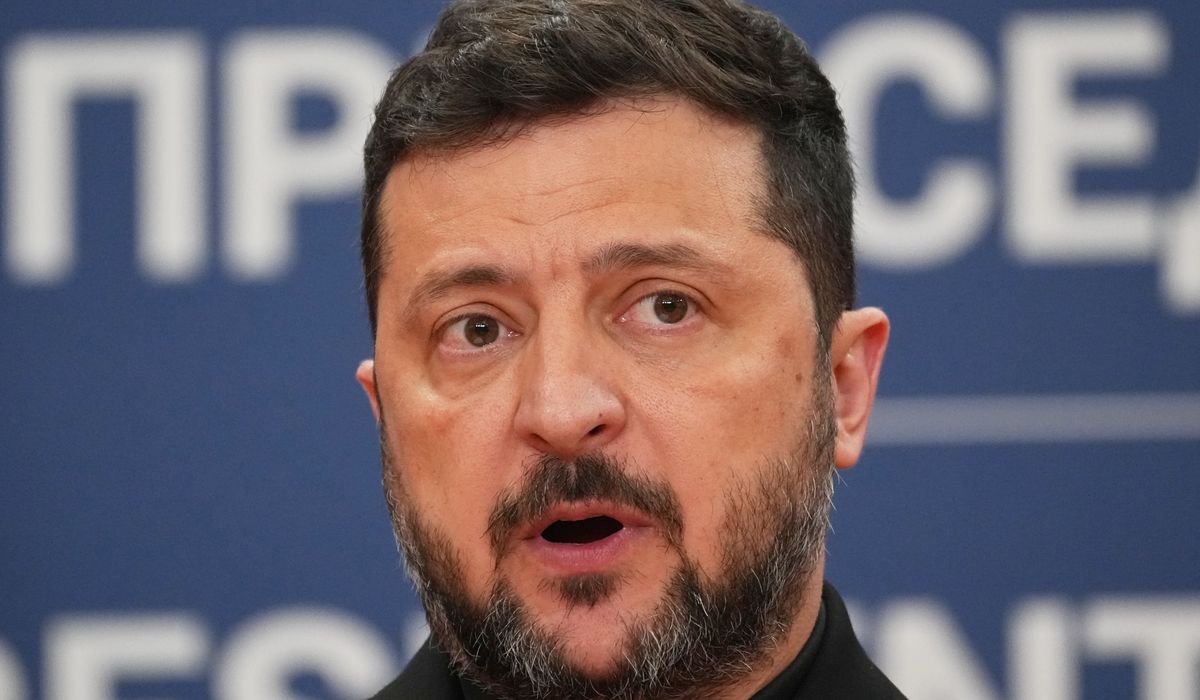
Ukrainian President Volodymyr Zelenskyy rejected calls for wartime elections, saying such political contests at a critical moment in his country’s war with Russia would “split Ukraine” apart.
In remarks made public Sunday, Mr. Zelenskyy pushed back against the call from ousted Ukrainian defense chief Mykhailo Fedorov, who last week said the nation is in a “crisis of governance” and suggested the situation warrants a presidential election.
Ukrainian law prohibits elections during wartime, meaning the country would have to pass new legislation or find another legal avenue to hold such a vote.
But Mr. Zelenskyy believes that would be a mistake.
“I believe that in a war like this, elections as such are a huge risk. Elections right now are a tsunami for the country that will split Ukraine,” the Ukrainian leader told reporters in remarks made public on Sunday.
Mr. Zelenskyy did not aggressively attack his former defense minister even while rejecting Mr. Fedorov’s call for elections.
“I really had and still have a very positive attitude toward Mykhailo. We have been through a lot together. But I believe that he himself goes, or is pushed, into the wrong things,” Mr. Zelenskyy said, according to English-language media accounts of his comments.
The rift between Mr. Zelenskyy and Mr. Fedorov has rapidly become a high-stakes political subplot to the ongoing Russia-Ukraine war.
Advertisement
In a nine-minute video released last week, Mr. Fedorov argued that Russia should not be allowed to determine how long Ukrainians go without choosing their leaders.
“Democracy cannot be held hostage by Russia,” the 35-year-old former minister said. “We must find a legal, safe and realistic mechanism that will allow Ukraine to renew its full democratic process even in the conditions of a long war.”
He stopped short of demanding an immediate vote or announcing a presidential bid.
Instead, he acknowledged some of the formidable obstacles to holding an election while Russia occupies roughly a fifth of the country, millions of Ukrainians live abroad and about 1 million are serving in the military.
Yet the speech went far beyond election logistics: Without mentioning Mr. Zelenskyy by name, Mr. Fedorov attacked corruption, opaque decision-making and a system in which loyalty is rewarded over competence.
Advertisement
Mr. Fedorov was dismissed last month after just six months as defense minister. He arrived with a background in defense tech, promising a data-driven approach he’d applied as Ukraine’s digital transformation minister to procurement, drones, mobilization and military management.
There are fears that the internal political strife in Ukraine could distract from a battlefield situation that has otherwise seen recent successes. Ukraine has carried out a campaign of drone strikes against targets deep inside Russia, demonstrating repeatedly — and very publicly — that Russian President Vladimir Putin’s military cannot stop Ukrainian aerial assaults on Russian soil.
Researchers with the Institute for the Study of War think tank said in a recent analysis that Russian forces have lost control of 10 square miles of frontline territory so far this month. Their analysis also said that Russian forces suffered more than 29,000 casualties since July 31, a remarkably high number that underscores why the Kremlin may pursue another fresh mobilization of Russian recruits.
Still, there are signs that a strong segment of the Ukrainian public may be open to a change in leadership, or at least the opportunity to reaffirm Mr. Zelenskyy’s leadership at the ballot box.
Advertisement
A Socis survey conducted from July 28 to Aug. 2 found 62.5% of Ukrainian respondents viewed Mr. Fedorov’s dismissal negatively or mostly negatively, while more than 57% supported the public protests against it.
In a hypothetical presidential contest, Mr. Zelenskyy received 22.3% among decided voters, while former armed forces chief and current ambassador to Britain Valerii Zaluzhnyi got 21.4%, and Mr. Fedorov 13.1%.
• Guillaume Ptak contributed to this article, which is based in part on wire service reports.
Story Topics