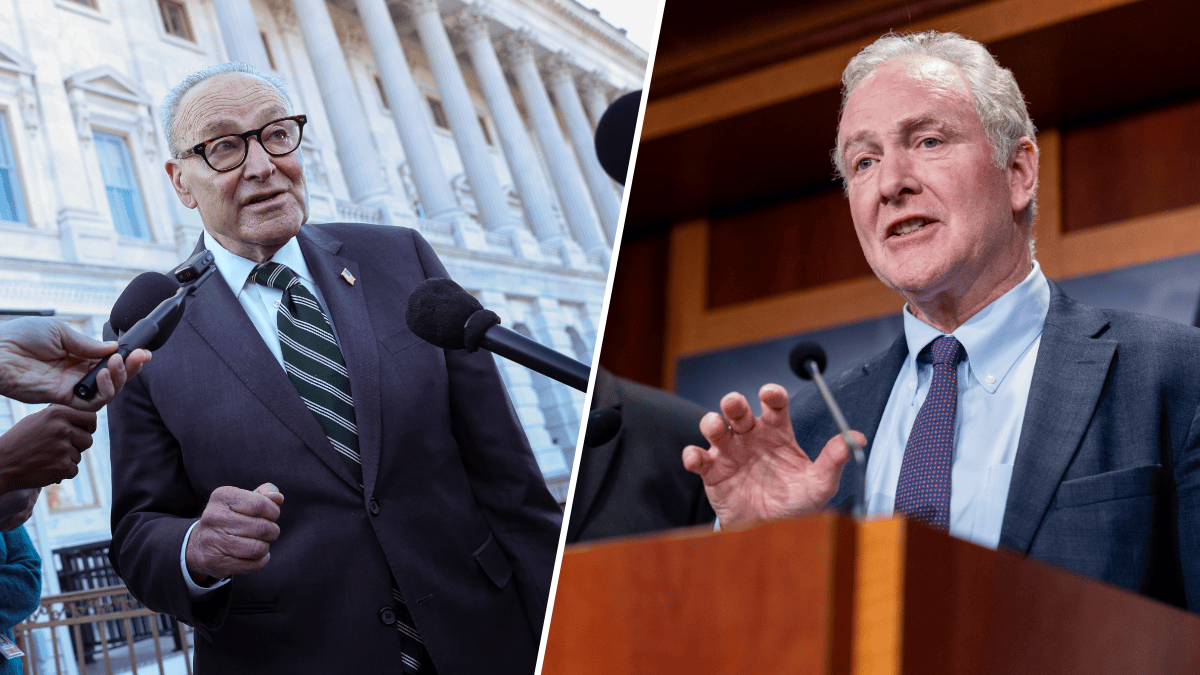
Sen. Chris Van Hollen and Sen. Angela Alsobrooks both represent Maryland. But when Van Hollen challenges Sen. Chuck Schumer next month in a bid for majority leader, he will not get Alsobrooks’ vote.
It’s at least in part because she had already committed to supporting Sen. Chuck Schumer before Van Hollen announced his challenge, Van Hollen said in his statement on the matter.
“While Senator Alsobrooks and I continue to speak about the future of our party, I respect her position that she made a commitment prior to when I joined the Majority Leader race,” Van Hollen said in a statement Thursday.
Van Hollen emphasized the respect between Maryland’s senators, despite their split on his run.
“These discussions among our party are critical to move our democracy and our caucus forward. And above all, they must be based in mutual respect and civility – there is no space in this discussion for vitriol or hostility,” Van Hollen’s statement continued. “Regardless of the outcome, Senator Alsobrooks and I will continue to respect one another and work together on behalf of Marylanders every day.”
Alsobrooks’ decision came without criticism for Van Hollen’s bid, Maryland Matters reported.
“Chris is a friend. He’s a respected colleague. He will continue to be that. He has every right to run in this and I support that,” Alsobrooks told reporters Wednesday.
Majority leader race serves as proxy fight in Democratic party’s split
The race for Senate majority leader was expected to be an orderly affair, with Schumer the anticipated winner. He remains likely to win.
But included in the next Congress’ large Democratic majority are a contingent of progressive new lawmakers who say voters want to see substantial change.
The size of the “blue wave” that carried Democrats to the majority in both houses of Congress stunned even the Democrats themselves. More traditional party members must now negotiate a path forward with a substantial progressive wing.
Differing priorities must now be consolidated into a coherent agenda, and Democratic leadership will help determine what the next steps are. New progressive lawmakers, and some of the voters who carried them into office, are pushing for different leadership in Congress.
The two contenders: Schumer and Van Hollen
Schumer, 75, first became Democratic party leader in 2017, when Democrats were in the minority. He’s remained party leader for the Senate for the past decade as Democrats won, then lost, the majority.
He’s faced criticism from members of his own party over his stances on Israel, his vote to pass a stopgap funding bill put forth by Republicans in early 2025 and his tight grip on planning sessions and the agenda.
Progressive voters have said they are frustrated that Schumer drags his feet on support for progressive candidates and on issues such as ‘Medicare for All” and say he has not done enough to fight the second Trump administration.
Van Hollen, 67, has also been in Congress for a majority of his career, has a similar position on many issues and has laid out similar goals for the new majority and taking on Trump, the Associated Press reports.
But the senior senator from Maryland has allied himself more strongly with progressive groups. Van Hollen has a handful of backers among the newest lawmakers in Congress, including Sens.-elect Abdul El-Sayed of Michigan and Peggy Flanagan of Minnesota. He is also supported by progressive leader Sen. Bernie Sanders and Oregon Sen. Jeff Merkley, the AP reports.
Some voters who favor Van Hollen view actions such as his trip to El Salvador to push for the return of Kilmar Abrego Garcia as proof he is willing to more actively fight against the second Trump administration than Schumer has.
Senators who support Schumer say being the leader is a difficult job, experience is necessary and Schumer has proven himself with legislative successes when they held the Senate under President Joe Biden, the AP reports.
The Washington Post reported that, as of Thursday, 16 senators have publicly committed to Schumer, while five have committed to Van Hollen. Another four have publicly opposed Schumer, with a few even campaigning on that point, but have not committed to Van Hollen specifically.
Virginia Sen. Tim Kaine told NBC News on Friday that he would not comment on his vote until after he gave it.
The vast majority of Democratic senators have not made statements about the contest one way or another.
The race for Senate majority leader will not take place until Dec. 1. It will be a closed-door vote with secret ballots — meaning how senators ultimately vote will not be made public.
The Associated Press also contributed to this report.