The Los Angeles area was hit by the strongest earthquake in 12 years on Saturday morning, followed by a robust series of aftershocks that jolted the region over Thanksgiving weekend.
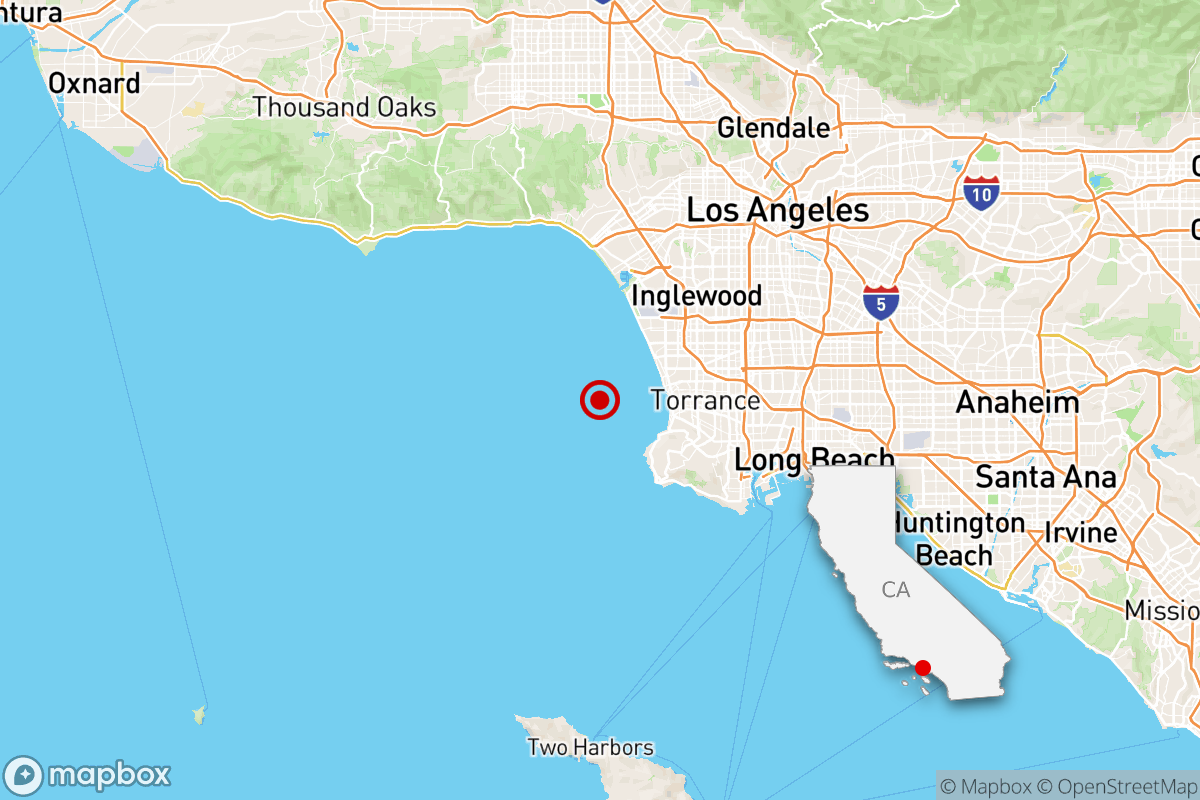
The magnitude 5 temblor, centered off the coast of Hermosa Beach, knocked items off shelves and caused ceiling panels to fall and glass panes to shatter at Terminal 7 in Los Angeles International Airport. At least one chimney collapsed. But there was no other major structural damage, or injuries, immediately reported.
Because the quake was centered so close to major population centers, it left many rattled and served as a reminder of the seismic danger Southern California faces.
“It is one of the larger ones we’ve had in the Los Angeles area in quite a while,” seismologist Lucy Jones, a Caltech research associate, said. In fact, it caused the strongest shaking the South Bay has felt since the Northridge earthquake of 1994, Jones said.
The last sizeable quake to hit the L.A. County-Orange County metropolitan area was the magnitude 5.1 temblor that hit the Brea-La Habra area in 2014. That quake caused more than $2.5 million in damage. A bit farther out, in Ventura County, a magnitude 5.1 quake southeast of Ojai hit in 2023.
“I’m sure the folks in the areas of, say, Redondo Beach, Manhattan Beach and along the coast there were pretty strongly shaken up,” said USGS seismologist Elizabeth Cochran. “But … we wouldn’t expect to have major structural damage, and that’s typically what we are concerned about when we talk about damage from earthquakes.”
It’s too early to say for certain which fault Saturday’s quakes were on. They probably occurred on the Palos Verdes fault or on a secondary reverse fault that splays off the main Palos Verdes fault, according to USC Earth sciences professor James Dolan. The Palos Verdes fault runs along the coast of Los Angeles and Orange counties and has the potential to cause a magnitude 7.8 earthquake.
Saturday’s main quake at 9:30 a.m. occurred on a thrust fault, “which means one side pushed up and over the other one,” Jones said.
Both the main quake and a 11:41 a.m. aftershock occurred about 7.6 miles under the surface, both relatively deep quakes. Scientists said the aftershock sequence seemed pretty active, with about 40 aftershocks by midday. There was also a magnitude 4 aftershock at 2:08 p.m. and a magnitude 3.9 at 2:27 p.m.
“This is on the robust side,” Jones said. “The reality is that aftershocks vary considerably. If you remember last week, we had a [magnitude] 5 with hundreds of aftershocks in Soledad [near California’s Central Coast], and the 3.9 in Commerce with no aftershocks. That sort of variation is what we see. This is probably a bit more active than average, but well within the normal range.”
The aftershock at 11:41 a.m. caused Manhattan Beach to close its pier as a precaution and the Redondo Beach Harbor Patrol to inspect its pier by boat. The beach at Hermosa Beach was closed to determine whether its pier was structurally safe. The Hermosa Beach Pier had been closed two days earlier due to concerns about extreme king tides and is considered to be in poor shape, with discussions underway about a possible replacement.
At Los Angeles International Airport, a white ceiling panel in Terminal 7 fell in the aftershock.
“People were scared,” said Kenna Cramer, 27, a family law attorney from Maryland who was boarding a United flight home to Washington. “There was a minor scream coming from a woman, then everyone calmed down.”
A plume of smoke was seen rising from the Chevron refinery in El Segundo. The company said that its automated safety systems were activated, “resulting in the intermittent use of the facility’s safety flares,” and that it “does not pose a safety risk to the community.”
Flaring is done to destroy any excess combustible gases that can develop in certain situations beyond a refinery’s control, according to the South Coast Air Quality Management District.
El Segundo Fire Chief Ryan Allee said the refinery’s emergency systems detected the earthquake and kicked in to prevent pressure from building in their web of pipes and lines.
“They have safeguards for product if the processing senses an issue. Well, the vibration from the earthquake stopped the processing but they have remaining product in the lines, and they don’t want that [product] to pressurize. So they essentially go to their flaring operations, which is a safety operation so we don’t have an incident,” Allee said.
“Strong” shaking was felt on land close to the epicenter, Jones said Saturday afternoon.
At least one home in Manhattan Beach experienced a chimney collapse. Elsewhere in El Segundo, there was “superficial damage,” Allee said. “Nothing that needed shoring up, and there weren’t any trapped victims. It was exterior pieces falling and glass breaking.”
The front glass window of Stuft Pizza on Main Street broke. At The Point restaurant and retail plaza at Pacific Coast Highway and Rosecrans Avenue, “some of their signage fell off … the big sign there, but nobody was injured,” Allee said.
“I feel fortunate. We have a lot of industry here in town, and so far, everything seems to be really holding up and I’m very happy about that,” Allee said.
The last major temblor to strike urban Southern California, the magnitude 6.7 Northridge earthquake of 1994, resulted in severe damage and the deaths of about 60 people. But the worst, most damaging shaking was mostly limited to a relatively small area of Los Angeles County.
There’s a 60% chance of a magnitude 6.7 or greater earthquake striking the Los Angeles region by 2045, according to USGS estimates published in 2015. There’s about a 1-in-5 chance of such a quake striking on the San Andreas fault within L.A. County and the Inland Empire.

(Quakebot / Los Angeles Times)
Whether people felt the Saturday morning quake for a long time or a short time depends on where they were located. Long Beach felt a major jolt and rumble, and houses swayed and dishes rattled in Inglewood.
“If you’re closer to the earthquake, you tend to feel the shaking as much sharper and shorter,” Cochran of the USGS said. “As you’re farther away from the earthquake, it will tend to feel like the shaking is going on for longer, and that’s just because the seismic waves travel at different speeds, and so they kind of spread out in time as you go farther away from the event.”
Several dozen shoppers and employees huddled in the parking lot of a shopping complex across the street from the refinery, after being escorted outside. Some looked visibly shaken; a few had their cellphones trained on the large column of thick black smoke twisting into the sky. There was no visible structural damage to any of the buildings. A slightly acrid odor hung in the air.
Video showed horns blaring as a Delta Air Lines plane was told to abort a landing just as the quake began. The camera shakes, and horns blare. “Delta [Flight] 1972, go around. Delta 1972, go around, we’re having a big earthquake,” a voice can be heard saying, according to Airline Videos Live, which airs live video of planes landing at LAX. The website FlightAware shows the flight climbing back up over Malibu, and then over downtown L.A., before landing at 10:01 a.m.
Delta Air Lines said another of its planes, Flight 1628, was also told to go around while the quake struck as it approached LAX. Both flights landed safely, the airline said.
The musical artist Lizzo said on social media that her plane landed as the earthquake hit. “I got the notification on my phone literally as wheels touched the ground,” she wrote. “Everyone please be careful!”
Broken glass was seen at LAX, tumbling near a security check-in line, according to a Fox News crew at a terminal for an unrelated story. A Fox News reporter said she saw people running out of restrooms, running for cover.
The USGS’ ShakeAlert earthquake early warning system was activated by the 9:30 a.m. and the 11:41 a.m. aftershock. Many people got the alerts, scientists said.
Jaime Prieto, 73, was with his family at home in Manhattan Beach when he felt a sudden jolt through the house and heard the dishes clattering slightly in the cupboards.
“It was very sudden and strong — very, very strong — but it was short,” he said. “That was the good part.”
They huddled together, waiting for an aftershock. After it came and went, they decided to take his young grandchildren, ages 4 and 7, outside “where it’s safer” and strolled over to nearby Live Oak Park.
Times staff writers Joseph Serna, Iliana Limon Romero, Robin Abcarian and Fidel Martinez contributed to this report.